


Social and relationship capital

Inputs
- Relationships with communities, customers, patients, consumers, regulators, HCPs, investors, suppliers, distribution partners, service providers, governments, media and other key stakeholders
- Responsible corporate citizenship
- Robust governance framework
- Integrated governance, risk and compliance structures
- Group-wide ethics and compliance processes
- Policies and procedures

Key initiatives
- Contribution to public health and social responses to COVID-19
- Ongoing engagement with key internal and external stakeholders and management of reasonable stakeholder expectations
- Socio-economic investment focused on enhancing healthcare delivery to communities
- Participation in the South African Public Healthcare Enhancement Fund, a collaboration between the South African Department of Health and private sector healthcare companies
- Support of Mandela Day across the Group's business units globally
- In-country initiatives aimed at community upliftment
- Support to empowering enterprises, including small and micro-enterprises, through preferential procurement and enterprise development and supplier development activities
- Contributing signatory to the UN Global Compact
- Implementation of Group-wide ethics and compliance programme
- Ethical culture risk assessment performed by The Ethics Institute in respect of 17 of the Group's most material businesses
- Further enhancements to ESG disclosures through provision of GRI, SASB and TCFD indices
- A focus on promoting equity in the Board and workforce composition
Outcomes
- Enhanced profile as a good corporate citizen with a reputation for high quality, affordable medicines and products
- Partnered with Johnson & Johnson to manufacture COVID-19 vaccines for distribution to South Africa and the rest of Africa
- Value delivered to stakeholders
- Increasing healthcare skills and resources, primarily in South Africa
- Meeting legitimate stakeholder expectations and maintaining a "licence to operate"
- Contributing to the transformation of South African society
- Contribution to the economies and fiscus in the countries in which we operate
- Uplifting the lives of the communities in which we work around the world
- Giving credence to our philosophy "Healthcare. We Care."
Value created for stakeholders

- Contribution to society through engagement with civil society and investment in SED
- Collaboration and partnering opportunities
- Responsible and ethical business partner
Material sustainability topics covered in this section:
- Human rights
- Ethical business culture
- Compliance
- Corporate governance
- Responsible supply chain management
- Transformation and economic inclusion (BBBEE in South Africa)
- SED and investment in communities
- Fair taxation

Conducting business in a responsible manner
Our responsible corporate citizen philosophy encapsulates our commitment to conducting business ethically, with integrity and with commercial wisdom. We strive to enhance the economic and social well-being of our patients, consumers, investors, employees, customers and business partners.
Engaging stakeholders
We are committed to adopting a stakeholder-inclusive governance approach and sustaining strong relationships with our stakeholders through transparency and effective communication. The Board takes overall responsibility for ensuring a stakeholder-inclusive governance approach and a Group stakeholder engagement policy is in place. During the year, we have had a wide range of structured and ad hoc engagements with our broad stakeholder base. Our approach to stakeholder engagement and a summary of the most material stakeholder engagements that we have undertaken are set out in Engaging with our stakeholders in this report.
Corporate governance
Led by an effective Board and long-serving, experienced executives, we operate on an established foundation of strong corporate governance. The King IV Report on Governance is implemented throughout the Group. More can be read about this on www.aspenpharma.com/corporate-governance-and-risk-management/ where we deal with our compliance with the King IV principles.
Ethics and compliance as a new combined function
Prior to 1 July 2021, the Ethics and Compliance portfolios at Aspen were separate, each residing in the Group Governance and Group Legal functional areas respectively. In addition, there was no independently managed SHE legislative compliance assurance function. The two portfolios are now combined, along with SHE legislative compliance assurance activities, in what now constitutes the Group's Ethics & Compliance function. The combined approach also applies across the businesses where Regional Ethics & Compliance Officers have been appointed to implement Aspen's settled Ethics & Compliance programmes within their businesses. The Group-wide Ethics & Compliance programmes, and the Group and Regional Ethics & Compliance teams, are led by the Group Head: Ethics & Compliance, who reports to the Group Executive: Governance & Communications.
Ethics management and Code of Conduct
We have a zero-tolerance approach to unethical behaviour. Our Code of Conduct is a values-based policy document that governs the conduct of all of our employees. It is aligned with the Organisation for Economic Cooperation and Development's ("OECD") recommendations regarding corruption and the 10 principles set out in the UN Global Compact. Our Code of Conduct, signed by all permanent employees, governs the conduct of employees throughout the Group. Furthermore, our service providers and suppliers are required to adhere to the Aspen Code of Conduct for Suppliers and Service Providers in accordance with terms and conditions included in agreements with these stakeholders. All new employees are given a copy of, and are required to sign their acceptance of the Code of Conduct on commencement of their employment with the Group. The Code of Conduct, which has been translated to all of the primary languages spoken by employees throughout the Group, is available to all employees on our Group's One Aspen Online intranet and is contained in the employee handbook made available to new employees. Our induction programmes across the Group are intended to educate new employees on the ethics, values and business philosophy of the Group, while formalised ethics-related training takes place for certain designated employees on an annual basis.
During the year, The Ethics Institute conducted an ethical culture risk assessment. The purpose of the assessment was to establish the current ethical culture risk profile for the Group. The quantitative and qualitative survey was conducted across 17 of Aspen's material businesses globally. The overall ethical culture ranking was assessed at the 85th percentile, indicating an "Advanced" overall ethical culture for the Group. The results of the survey will be used to focus interventions on specific areas required to further enhance our ethics programme.
The Group Executive: Governance & Communications provides assurance to the Social & Ethics Committee in respect of the annual completion of the essential elements of the Group's Ethics Management programme by submitting a certification confirming the completion of these elements. The Group's Internal Audit function provides additional assurance to the Committee in respect of the satisfactory implementation of the programme as it conducts regular and targeted risk-based reviews to confirm the appropriate implementation of the programme throughout the Group.
Anti-bribery and corruption
We are committed to the eradication of bribery and corruption. Our stance on bribery and corruption, as outlined in our Code of Conduct, is strengthened by our Anti-bribery and Anti-corruption policy, applicable to all our employees, suppliers, service providers, consultants and agents or other third parties authorised to act on our behalf. This policy is aligned with the recommendations of the OECD on corruption and prohibits any employee or agent of Aspen from directly or indirectly offering, paying, soliciting or accepting bribes in any form. Read with our Gifts and Benefits policy, it also prohibits the acceptance or giving of gifts or hospitality that are not of a nominal value or participating in events sponsored by current or prospective customers or suppliers. The Anti-bribery and Anti-corruption policy, which describes the elements and types of corruption and bribery, is available to all employees. Our annual ethics training programmes include anti-bribery and corruption risks and our policy stance thereon, with specific training on the topic provided to certain designated employees. During the year, no instances of bribery or corruption were investigated, and no employees were disciplined or dismissed due to non-compliance with our Anti-bribery and Anti-corruption policy. No fines, penalties or settlements were incurred in relation to corruption.
Tip-Offs Anonymous Hotline and other whistleblowing reports
We promote a culture of openness and transparency throughout the Group and, as such, employees and other stakeholders are encouraged to report unethical conduct and other transgressions which they may become aware of. An independently monitored whistleblowing hotline, (including facilities to email anonymous tip-offs reports or log them online), Deloitte's Tip-Offs Anonymous, remains available to all our employees and allows other stakeholders to report suspected fraud and/or activities which are considered to be transgressions of our Code of Conduct. Our policy and standard operating procedure provides guidance to prospective whistle-blowers and details the protections available to them, including protection against occupational detriment. Training and awareness sessions are conducted periodically to promote the use of this facility for its intended purpose. Key customers, service providers and suppliers are periodically informed of the availability of this line.
All reports from this hotline or from other whistleblowing sources received during the year were logged and, where appropriate, reported to the relevant managers timeously after consideration by the Aspen Ethics Committee. Disciplinary action was taken in instances where employees were found to have transgressed, with corrective actions implemented where necessary to improve controls and to prevent recurrence of the incident. All instances of misconduct, which may also constitute criminal conduct, are reported to local prosecution authorities as may be appropriate. Reports detailing the tip-offs received, how these tip-offs have been investigated and the corrective measures taken, are submitted to the Audit & Risk Committee and Social & Ethics Committee on a quarterly basis.
The table below provides a breakdown of the tip-offs received via the Tip-Offs Anonymous Hotline and other whistleblowing sources from across the Group during the year:
| Type of allegation | |
| Fraud/theft/arson | 7 |
| Bribery/corruption by Aspen employees/contractors | 2 |
| Unethical business practices/breach of policies or procedures | 3 |
| Sexual harassment | 0 |
| Human Resources/grievance-related complaints | 30 |
| Other | 6 |
| Total | 48 |
Of the 48 allegations received via the Tip-Offs Anonymous Hotline and other whistleblowing sources during the financial year, all have been considered by the Social & Ethics Committee and 43 were deemed to have been resolved, with five matters still under investigation.
One instance of reported alleged misconduct (reported to the responsible Regional Ethics Officer) was found to be of material substance and was accordingly investigated. The three implicated employees were dismissed following a formal disciplinary process.
Respecting human rights
We are a signatory to the UN Global Compact and are committed to upholding the principles of respecting and protecting internationally proclaimed human rights, as well as ensuring that we are not complicit in human rights abuses. The Aspen Code of Conduct details our commitment to fundamental human rights and the Social & Ethics Committee monitors the effectiveness of ethics management in the Group. The Aspen Group statement on modern slavery further supports our commitment to address the requirements of the UK Modern Slavery Act, the Australian Modern Slavery Act and equivalent legislation in the jurisdictions in which we operate. All our suppliers and business partners are required to confirm acceptance of the Aspen Code of Conduct for Suppliers and Service Providers to provide assurance that human rights and good ethical standards are upheld within the supply chain.
Our formalised Ethics programme requires each business unit to assess risks associated with violating human rights, child labour, as well as slave or compulsory behaviour. No businesses in the Group identified heightened risks in this regard and during the year, no incidents of discrimination, slave labour or compulsory labour were reported within the Group (2020: Nil).
As part of our commitment to good corporate citizenship, we support the United Nations Declaration on the Rights of Indigenous Peoples as adopted on 13 September 2007 and respect the rights of indigenous peoples in the countries and territories in which we operate. There were no reported incidents where the rights of indigenous people were violated (2020: Nil). These aspects are monitored in respect of all business units.
The Social & Ethics Committee provides oversight of the Group's human rights performance.
Conflicts of interest
The Board has adopted a formal policy to regulate conflicts of interest. Directors or employees who encounter such conflicts are required to formally declare such conflicts of interest for these to be considered by the appropriate forum, which is to provide direction as to how such conflicts are to be resolved and recorded. We also have a formal policy that deals with trading in Aspen's securities.
Responsible supply chain management
We work with a large number of suppliers, who provide goods and services that support us in delivering a reliable supply of high quality, safe products for our patients and consumers. We acknowledge that we have a responsibility to ensure that we work with suppliers and partners whose ethical, social and environmental standards are aligned to our own. Our service providers and suppliers are required to adhere to the Aspen Code of Conduct for Suppliers and Service Providers in accordance with terms and conditions included in agreements with these stakeholders. In agreeing to the provisions of this document, these parties warrant that:
- They do not use or engage in child labour or indentured labour;
- A safe and healthy workplace is provided for employees;
- Employees are not unfairly discriminated against;
- No corporal punishment and no form of abuse or cruelty is applied or supported;
- Each employee is paid at least a minimum wage or a fair representation of the prevailing industry wage;
- All laws on working hours and employment rights relevant to the business are complied with; and
- Employees are free to join and form independent trade unions and have the freedom of association.
In order to enhance our engagement with our key service providers and suppliers, we are in the process of developing a Group-wide supplier sustainability risk assessment and due diligence programme for implementation in CY2022. This Responsible Supply Chain Programme will allow us to monitor sustainability performance on a routine basis through reliable sustainability assessments and engage with suppliers to achieve continual improvement and advancement of supplier performance on relevant sustainability aspects.
Responsible tax citizen
As a Group that has a substantial presence in many countries, we understand our responsibility to pay an appropriate amount of tax. We comply with tax laws in the countries in which we operate and seek to maintain open and positive relationships with tax authorities. The taxes we pay make a positive contribution to the societies in which we operate. Our approach to taxation is set out in Financial capital in this report.
Political contributions
Our Code of Conduct precludes us from making payments or other contributions to political parties, organisations or their representatives or taking part in party politics.
Legislative compliance
Lawful compliance and respect for the rule of law underpins an ordered and effective society. We are committed to complying with the applicable legal and regulatory requirements wherever we do business. The Group Executive: Governance & Communications is responsible for the implementation of an effective legislative compliance framework and provides the Board with assurance in respect of the Group's compliance with applicable laws and regulations.
There were no significant incidents of legislative infringements recorded during the year under review reflecting the Group's effective compliance management and governance processes.
Socio-economic development and investment in communities
Our SED programmes are implemented at a local level through the business units, thereby channelling contributions to areas of greatest impact in the particular local context. A Group SED Policy has been adopted and implemented, aimed at aligning the Group's SED contributions with its SED strategy and ensuring compliance with the Aspen Code of Conduct. There is also a Group SED Committee in place to monitor and review the implementation of this policy and approve SED investments in excess of certain thresholds.
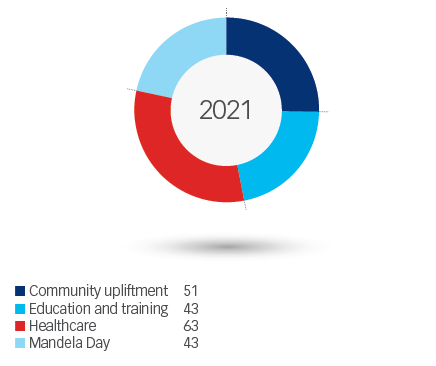
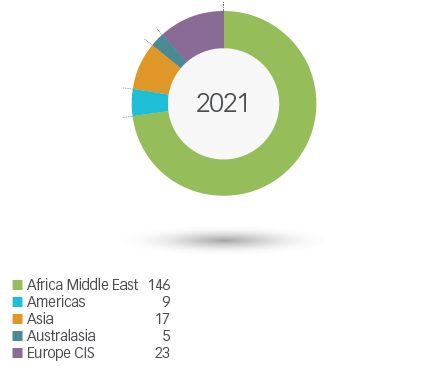
During the year, we supported a total of 200 SED projects, valued at R19,5 million and based largely in South Africa.
SED projects by type across the Group (200 projects)
SED projects supported per region (200 projects)
Supplementing efforts to rebuild the economy, healthcare sector and communities in South Africa
The ongoing effects of the COVID-19 pandemic have continued to inflict both unprecedented public health and economic challenges with the obvious need to balance lives and livelihoods. To this end, over the past year, we have further focused and enhanced our efforts to respond to the public health challenges and positively contribute towards economic recovery and rebuilding the economy. The negative impact of the recent unrest in certain areas of KwaZulu-Natal and Gauteng, in South Africa, have required an immediate response in terms of rebuilding and restoring a sense of normality within the affected communities. Aspen has played an active role in this restoration, including addressing investor sentiment and practical on-the-ground responses by helping to rebuild affected health facilities, pharmacies and GP practices in the affected areas.
These efforts were further reinforced through partnerships with community-based and government organisations, whereby notable assistance was provided within communities. This year, we have partnered with various organisations in providing food and care parcels on a sustainable basis, in order to provide resource-constrained communities, some stability during an already turbulent economic time.
We have continued our partnership within the Business for South Africa platform, by leading the health workstream. The core focus of Business for South Africa ("B4SA") has been in combating the COVID-19 pandemic in South Africa through voluntary, pro bono work. While initial efforts were directed at securing personal protective equipment for frontline healthcare workers, the vaccine roll-out in South Africa has become a focal point for B4SA, which has made notable contributions in the efforts to ramp up vaccination in order to achieve government's goal of vaccinating 28 million adults living in South Africa by the end of December 2021.
Our SED priority areas include:
- Community development and health infrastructure support;
- Rebuild South Africa campaign ;
- Social development, strengthening democracy and civil society;
- Humanitarian/COVID-19 relief; and
- Human capital and skills development
Notable SED initiatives we supported during the year include:
- Our contribution towards the establishment of a modular hospital solution in partnership with Siemens and the German government at the Cecilia Makiwane Hospital in the Eastern Cape. The facility will provide further capacity for the hospital, adding 100 beds and state-of-the-art diagnostic equipment;
- Our contribution towards the establishment of tents at the Chris Hani Baragwanath Hospital which provided extra capacity in the initial vaccine roll-out programme for healthcare workers and staff;
- We provide continued support for the young female students in the Nkantolo community in partnership with the O.R. and Adelaide Tambo Foundation through the donation of sanitary towels for each student for a period of six months;
- We have an ongoing partnership with the University of Witwatersrand Pharmacy School to provide support for its bursary programme as well as its SED-related activities, including its Trinity Pharmacy initiative, which provides health services for the homeless and destitute in and around the Johannesburg CBD; and
- Support was provided to the Cape Town Disaster Management organisation during the fire that broke out at the University of Cape Town in April. We provided Aspen-branded eye drops for fire fighters and first responders. We further contributed towards the restoration of the building that was damaged in the fire and other supplementary activities.
During these challenging turbulent times that South Africa and the world faces, Aspen continues to invest in SED initiatives, where optimal impact can be realised in rebuilding and restoring communities through collaborative efforts.
SED spend on projects in South Africa
| R'million | % | |||
| Basic health and HIV/AIDS (including spend on clinics, HIV/AIDS and healthcare) | 4,9 | 31 | ||
| Education and training | 8,7 | 54 | ||
| Sport and the promotion of healthy lifestyles | 0,2 | 1 | ||
| Other (including Mandela Day and community upliftment) | 2,2 | 14 | ||
| Total | 16,0 | 100 |
Commitment to transparency in reporting
We appreciate that our stakeholders expect us to report on a broad range of ESG aspects in a consistent and transparent way. We perform a review of material sustainability topics to understand the expectations of our stakeholders (refer to Our approach to sustainability). Since the implementation of the FTSE/JSE Responsible Investment Index in 2015, we have worked at improving our overall score, resulting in our inclusion in 2020 in the top 30 of the FTSE/JSE Responsible Investment Index and in the FTSE4Good Index Series, which recognises companies with strong ESG practices measured against global standards. In the most recent assessment, our score reduced to 3,9 (2020: 4,5) out of a possible 5,0 after being impacted by the change in the index scoring methodology relating to climate-related criteria. Nevertheless, we continue to place above the 90th percentile in our industry sub-group on the index.
In order to further enhance our transparency in reporting, we have provided an initial mapping of our disclosures to the GRI standards and SASB standards and have also commenced aligning our disclosures with those recommended by the TCFD. These indexes can be found in our Sustainability and ESG Data Supplement.
Transformation and economic inclusion in South Africa
As a proudly South African-based group, we support the country's transformation objectives aimed at empowering historically disadvantaged groups in South Africa and we subscribe to the notion that, through the legislated economic empowerment initiatives, South Africa will benefit from the social reparation of past injustices and from the added economic contribution of inclusive and unrestricted participation by all citizens.
We have developed transformation objectives and programmes, and our employee management policies in South Africa are aligned with the Employment Equity Act and the BBBEE Codes to promote the advancement of historically disadvantaged individuals and women. In light of the significance we place on achieving progress in this regard, the performance against our Employment Equity plan is monitored by the Social & Ethics Committee, while our transformation KPIs are reported to the Board. Refer to Human capital for further information on our initiatives to empower historically disadvantaged individuals in South Africa.
In addition, enterprise development programmes and preferential procurement objectives and targets are in place to support the emergence of black-owned and black female-owned businesses. While COVID-19 resulted in a reduction in total procurement spend in South Africa, we were able to substantially maintain the proportion of our total measured procurement spend with empowering suppliers. In this regard, the Group spent R3 366 million (2020: R3 190 million) with BBBEE-recognised locally based suppliers, representing 82,0% (2020: 82,9%) of total measured procurement spend. Our spend with black women-owned businesses increased from 13,9% to 14,9% of total measured procurement spend. Through continued efforts to onboard new black-owned businesses, we achieved an increase in the percentage of measured spend from these suppliers (from 22,1% in 2020 to 28,5% this year). We continue to focus on procurement from designated groups; however, our performance was negatively impacted by certain large suppliers losing their designated group status. We spent R12 million (0,3% of total measured procurement spend) with designated groups, falling short of the target of 2,0%.
Through our enterprise development and supplier development programmes, we continue to support our selected beneficiaries and this has included the extension of repayment holidays during the COVID-19 period where required. The balance of these loans as at 30 June 2021 is R39 million.
We have maintained our Level 4 BBBEE contributor status for the year. The Group's BBBEE certification was performed by Empowerdex, an independent economic empowerment rating and research agency. The 2021 certificate can be accessed  online.
Accolades
Aspen Pharmacare was awarded the Business Excellence Award in ESG within the Pharmaceutical sector for 2021 by PMR.africa.
Aspen Pharma Brazil received an award from the Albert Einstein Hospital, based in São Paulo, Brazil for its outstanding support in the fight against the COVID-19 pandemic.
The Chevalier de l'Ordre national du Mérite (Knight of the French National Order of Merit) was bestowed upon Stephen Saad, Aspen's Group Chief Executive, at the University of Pretoria by President Emmanuel Macron.
Aspen's Integrated Report 2020 was awarded an "Excellent" rating by EY in its Excellence in Integrated Reporting, and the highest ESG data transparency score in the Health and Pharmaceuticals sector by Integrated Reporting & Assurance Services in its Sustainability Data Transparency Index.
Additional information available online:
- Aspen Sustainability and ESG Data Supplement
- Social & Ethics Committee Report
- Audit & Risk Committee Report
- Aspen Code of Conduct
- Aspen Code of Conduct for Suppliers and Service Providers
- Aspen's 2021 BBBEE Report
- Aspen's 2021 Communication on Progress Report in respect of Aspen's application of the UN Global Compact's 10 Principles
- BBBEE philosophy