


Natural capital

Inputs
- Natural resources which we use such as water, air, land, minerals and biodiversity
- Energy derived from non-renewable energy sources such as coal and natural gas and renewable energy sources which includes solar, wind and biomass
Key initiatives
- Ongoing commitment to containment and reduction of our carbon footprint and reliance on fossil fuels from the activities we undertake through site management strategies, formal conservation projects and renewable energy initiatives
- Monitoring of emissions across manufacturing sites
- Responsible water management and usage across manufacturing sites
- Participation in the annual CDP-CC and CDP-WS
- Committing to support management recommendations on the TCFD by disclosing our governance framework, climate strategy and related risk management approach
- Implementation and monitoring of systems and processes in place to manage hazardous and non-hazardous waste
- Promotion of waste reduction and recycling initiatives across manufacturing sites
- Monitoring and control of the quality of effluent discharge
- Contributing signatory to the UN Global Compact, aligned with its principles in respect of environmental stewardship
- Compliance with ISO 14001 Environmental Management System by manufacturing sites in Gqeberha, East London, Cape Town, Nairobi, Bad Oldesloe, Vitória, Dandenong, Oss and Notre Dame de Bondeville
- Compliance with ISO 50001 Energy Management System in Bad Oldesloe and Notre Dame de Bondeville
Outcomes
- Ensuring a sustainable supply of energy and water, critical to our ability to operate
- Reduction of carbon footprint
- Cost containment as a result of energy and water-saving initiatives, allowing for competitive manufacture
- Responsible disposal and management of hazardous and non-hazardous waste, resulting in an increase in waste recycled and a reduction in waste to landfill
- Reduction of environmental pollution, risk and incidents
Value created for stakeholders

- Responsible management of our impact on the environment
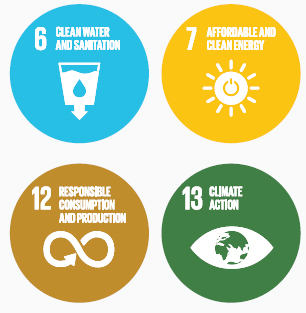
Material sustainability topics covered in this section:
- Climate change and GHG emissions
- Energy efficiency
- Water and effluent
- Waste
Approach to environmental stewardship
We are committed to promoting responsible environmental stewardship, seeking to minimise any negative impact our operations have on the environment and to comply with applicable laws, regulations and other environmental management requirements. We promote the efficient use of resources such as energy, water, packaging and production materials, with due regard to the scarcity of natural resources and the environmental impact resulting from the utilisation and application of such resources in conducting our business activities. We are a signatory to the UN Global Compact and fully support global initiatives aimed at protecting the environment and conserving natural resources.
The implementation of our Environmental Management Protocol (incorporating the Group's environmental management principles) and compliance with all applicable environmental legislation are the responsibility of designated business unit executives.
Our Board monitors the status of environmental risks through the review of material environmental management performance indicators at scheduled intervals. In addition, any significant environmental risks are escalated through the Group risk management process. The Social & Ethics Committee assists the Board in monitoring compliance to the relevant environmental legislation and monitoring the adequacy of environmental management systems. Under the direction of a Group executive, the Group SHE function develops and promotes our environmental management principles and standards, monitoring the alignment of business units' environmental management systems to the Group's standards.
Our environmental management systems are aligned to global standards, with all of our fully commercialised primary FDF manufacturing facilities and all, but one, of our API manufacturing facilities currently complying with ISO 14001:2015. Our regional production site in Kenya achieved its ISO14001 certification this year. The Sioux City and Ghana sites have been excluded from certification due to the limited scale of the operations.
During the year, a number of environmental training interventions were conducted across the manufacturing sites to ensure consistent application of environmental principles, standard operating procedures and compliance with legislative requirements, and to create awareness of new developments. The Group participates in a number of industry platforms in order to keep abreast of initiatives and technological developments focused on the efficient use of scarce natural resources. Awareness campaigns were rolled out across the Group in celebration of World Water Day and World Environment Day.
An external legal assurance process was conducted in 2020 and no exceptional legal environmental findings were noted, while improvements were achieved in the management of air emissions, water and waste. No fines were paid in respect of environmental non-compliances this year.
The Aspen Code of Conduct for Suppliers and Service Providers requires our vendors to conduct their business in an environmentally conscious manner and to ensure compliance with the applicable environmental legislation.
Material environmental issues
There are no material environmental issues to report.
Preserving the environment
Managing emissions
Climate change is undoubtedly one of the greatest challenges facing the world and we are cognisant of its effects on our health, livelihoods, natural habitats and ecosystems, as well as extreme changing weather patterns. We recognise the potential environmental, social, political and economic implications of climate change as a significant issue. Our environmental management principles promote the containment and reduction of our carbon footprint in our operations and in the broader supply chain in a technically and economically feasible manner through structured systems of environmental monitoring, reporting and management. We pursue this objective through the investment in energy-efficient equipment and the utilisation of green energy technologies where feasible. In addition to this, we have taken a strategic decision to implement bolder initiatives towards climate change. This process will commence with developing a Group position statement on climate change, highlighting our intention, commitments and support of the SDGs. The strategy also includes identifying longer-term climate-related risks with the intention to complete a company-wide climate risk assessment, formalisation of company-wide targets and development of strategies to achieve these targets.
Scope 2 emissions, comprising purchased steam and purchased electricity, represent our largest source of emissions. The main sources of our Scope 1 emissions are from fugitive refrigerants and the consumption of fuel and natural gas used primarily in our stationary combustion equipment such as boilers and standby generators, and the operation of Aspen-owned vehicles.
Scope 1 and Scope 2 emissions for the Group have increased and decreased by 3% and 7%, respectively. The increase in Scope 1 emissions is attributed mostly to an increased production output recorded for 2021 for our Sterile facility SVP2 manufacturing facility in Gqeberha. Successful implementation of continual improvement projects at, most notably, the FCC facility in Cape Town and our manufacturing facilities in Gqeberha enabled lower energy consumption and a decrease in related Scope 2 emissions.
Over the past five years, a decrease of 10% (21 002 tCo2e) in combined Scope 1 and 2 emissions for the Group was realised. The operations in South Africa contribute 63% of our carbon footprint, followed by the Oss site (17%). Although the divestment of the Nutritionals business at the end of 2019 resulted in a significant reduction in emissions for the Group, lower energy consumption from the closure of several plants at Oss, including a solvent recovery unit, contributed largely to the reduction in Scope 1 and Scope 2 emissions. A notable reduction in Scope 2 emissions was also achieved through equipment optimisation at Oss which included upgrading of the boiler house, installation of variable frequency drive refrigeration compressors and LED lighting, and the replacement of a demineralised water installation. Despite the increase in energy required for expansion at the Gqeberha facility over the past few years, several installations relating to solar energy, LED lighting, hot water heat pumps, chiller plants, as well as modifications to heating, ventilation and air conditioning ("HVAC") and air change rates, were successfully implemented or optimised.
Scope 1 emissions (44 544 tCo2e) (%)

Scope 2 emissions (143 126 tCo2e) (%)

We continue to participate in the CDP-CC and achieved a "C Awareness Level" rating in 2020 which recognises knowledge of climate issues and the associated impacts. We are striving to improve our rating through the setting of company-wide carbon emission reduction targets and conducting climate change risk assessments which include scenario analysis.
In accordance with GMP regulations, we have installed technically advanced air handling systems and exhaust filtration systems at all relevant facilities to maintain the correct environmental conditions and minimise the risk of the release of harmful substances into the atmosphere. Through the implementation of periodic stack emission tests, we have established that the systems implemented have minimised harmful air emissions to immaterial levels.
TCFD
We acknowledge the increasing expectations for greater transparency in reporting around the impacts, risks and opportunities of climate change. We are progressively reviewing and aligning our management and reporting approach with the recommendations of the Financial Stability Board's TCFD. The majority of requirements are addressed in our annual CDP-CC submission, available on our website. A table summarising our current reporting in terms of the TCFD's recommendations is included in our Sustainability and ESG Data Supplement.
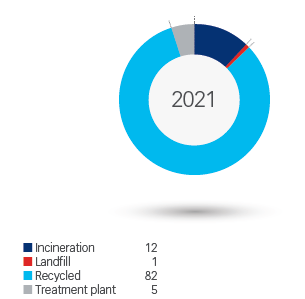
Waste generated by disposal method (70 723 tonnes) (%)
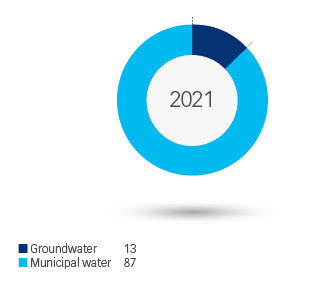
Water withdrawal (1 096 megalitres) (%)
Responsible management of waste
As part of the pharmaceutical and chemical industries, a fair portion (29%) of our waste is classified as hazardous. Specific systems and processes are in place to manage both our hazardous and non-hazardous waste in compliance with the waste management legislation applicable in each territory. We use specialised licensed waste management service providers to manage the transportation, treatment and disposal of waste in accordance with contracted terms and relevant legislation.
A slight reduction of -1% in total waste generated was achieved in 2021. The continuous promotion of waste recycling as well as initiatives to significantly reduce waste disposed to landfill are ongoing for the entire Group. The percentage of waste recycled during 2021 remained consistent at 82% compared to the prior reporting year. Only 1% of total waste generated is landfilled.
Responsible management of effluent
The quality of effluent discharge is monitored and controlled across all sites, in accordance with local municipal by-laws. Water treatment plants are in operation where required to ensure legal compliance. In the event that there is a deviation from the required standards, a thorough root cause analysis is conducted and corrective action plans are implemented.
Biodiversity
As at year-end, none of the Group's business units were located in conservation areas or areas of high biodiversity.
Spills and soil contamination/ground pollution
With our continued focus placed on implementing necessary corrective and preventive actions to curb incidents of spillages, we managed to achieve a notable reduction in the total number of significant spills during 2021. A total of two significant spillages were recorded in 2021, in comparison to six in 2020. A negligible portion of the total volume of reported spillages was not fully contained and the polluted ground was remediated.
Managing the efficient utilisation of scarce natural resources
Water
We use water extensively in our manufacturing processes, in the cleaning of our equipment and facilities, for employee hygiene, in steam generation and to maintain the required manufacturing environmental conditions. Municipal water is the primary source of water across the Group, although groundwater is also used at the manufacturing sites in Notre Dame de Bondeville, Oss, Dar es Salaam, Hyderabad and the leased facility in Vallejo. Water scarcity and water supply are global risks that are increasing in impact and probability. In addition to climate change-related risks, sustainable water supply is further exacerbated by increased urbanisation and the ageing municipal infrastructure in certain areas.
As a scarce resource, we recognise that initiatives aimed at conserving and harvesting water will contribute to more sustainable water availability. We are committed to ensuring responsible water management at all our manufacturing facilities, as per the stated environmental management principles. We conduct an annual review of our water risk and water stress assessments for all manufacturing sites using a web-based tool in order to better understand our exposure to these risks and inform our future sustainable water management and water stewardship initiatives.
For the assessment and quantification of water stress, we use the World Resource Institute's Aqueduct Water Risk Atlas, which indicates water risk trends of what can be reasonably expected based on historic data. The assessment tool allows us to understand current water risks and anticipate future risk based on the measured ratio of total water withdrawals to available renewable surface and groundwater supplies in the respective water basins. Our sites in Vallejo, Cape Town and Hyderabad are situated in extremely high water-stressed areas. The Aqueduct Water Risk Atlas does not currently classify Gqeberha as a high water stress location. However, considering surface water availability in the region, we have included this site in the top water risk category. The water withdrawn from these sites represents 31% of total water withdrawn for the Group.
Our manufacturing sites in East London, Dar es Salaam, Accra, Sioux City and Notre Dame de Bondeville are considered to be situated in low water-stressed locations. Future projections show that our manufacturing sites in Gqeberha and Cape Town, Hyderabad as well as Dandenong will be extremely water stressed in the next five to 10 years.
| Extremely high water stressed | High to medium-high water stressed | Medium-low to low water stressed | Total | ||
|---|---|---|---|---|---|
| Water withdrawn | Mℓ | 345 | 480 | 271 | 1 096 |
| Water discharged | Mℓ | 218 | 431 | 208 | 857 |
| Water consumed | Mℓ | 127 | 49 | 63 | 239 |
| Water withdrawn | % | 31 | 44 | 25 | 100 |
| Water discharged | % | 25 | 51 | 24 | 100 |
| Water consumed | % | 53 | 21 | 26 | 100 |
Water withdrawn has decreased by 9% (108 megalitres) for the year. This is attributable mostly to the decommissioning of cooling towers at Moleneind, Oss, the successful implementation of a closed loop circulation system for chilled water at Shelys and conservation projects at Notre Dame de Bondeville. In addition, water demand at FCC was lower during 2021 due to reduced operations in certain production centres which resulted in less frequent cleaning activities.
Over the past five years, water withdrawal has reduced significantly by 34% (571 megalitres) within the Group. The Oss and Gqeberha facilities contribute to more than 50% of the volume of water consumed by our manufacturing operations. Although the divestment of the Nutritionals business at the end of 2019 resulted in a notable water reduction for the Group, the Oss facility played the most significant role in realising the positive downward trend with a water reduction of more than 300 kilolitres from 2017 to 2021.This was attributed largely to the decommissioning of a water purification plant in De Geer, cooling towers and a chemical plant at Moleneind, the disposal of the operation at Corelli Straat, and the use of efficient closed water-based cooling systems all based in the Netherlands.
We participated in the annual Water Security Disclosure Project in 2020 and maintained a performance score of "B- Management Level". Our B- rating is within the "Management" band which recognises companies that are assessed as taking actions associated with good water management.
Energy
Electricity is a critical resource utilised in our manufacturing processes and is becoming an increasingly expensive commodity. In South Africa, there continues to be a risk of supply interruptions at times of excessive load on the national electricity grid and load shedding is still implemented intermittently by Eskom, the public power utility. While our Gqeberha and East London sites were not subject to load shedding, FCC did make use of generators to provide electricity requirements at times of load shedding. The Group's annual electricity usage for 2021 has decreased by 3% (18 541 gigajoules) in comparison to the prior year. This reduction was attributed mainly to energy conservation projects realised at the FCC and Gqeberha manufacturing sites in South Africa.
Through the efficient use and conscious conservation of electricity we are committed to reducing the impact of increased electricity prices on production costs, and will ensure that critical energy resources are conserved.
Additional energy sources utilised by Aspen are fuel, liquid petroleum gas, purchased steam and natural gas.
Accolades
In 2021, Beta Healthcare International Limited participated for the first time in the Energy Management Awards, hosted by the Kenya Association of Manufacturers. Following the company's robust energy management initiatives, which include the establishment of policies, planning, implementation and monitoring, under the category of small consumers, Beta Healthcare was awarded first runners up in the "Best New Entrant – Small Consumers" award.
Energy usage by source type (193 696 GJ) (%)

Additional information available  online:
- Aspen Sustainability and ESG Data Supplement
- Aspen Environmental Management Protocol
- CDP-CC 2021 submission
- CDP-WS 2021 submission
- IBIS Assurance Statement
- Communication on Progress Report in respect of Aspen's application of the UN Global Compact's 10 Principles for 2021
- ISO 14001 certificates
- ISO 50001 certificates