


Our risks and opportunities
Risks are inherent to our business. Our operating environment is complex, dynamic, highly regulated and uncertain. Identifying, analysing and responding appropriately to these business risks is vital to attaining our strategic objectives, protecting the interests of stakeholders and meeting legal requirements. Our success depends not only on our ability to minimise downside impacts, but also on our ability to capitalise on the potential opportunities for value creation presented in an uncertain future.
An integrated approach to risk management
The identification and management of risks is central to achieving our strategic objectives. it protects us against potential negative impacts, enables us to take risk for strategic reward and improves our resilience against emerging risks. To this end, we have an integrated approach to risk management, giving due consideration to economic, environmental and social factors which impact Aspen and our stakeholders. Both the opportunities and threats underlying each identified risk are considered to ensure a balanced outcome between risk and reward for the sustainability of the Group as a whole.
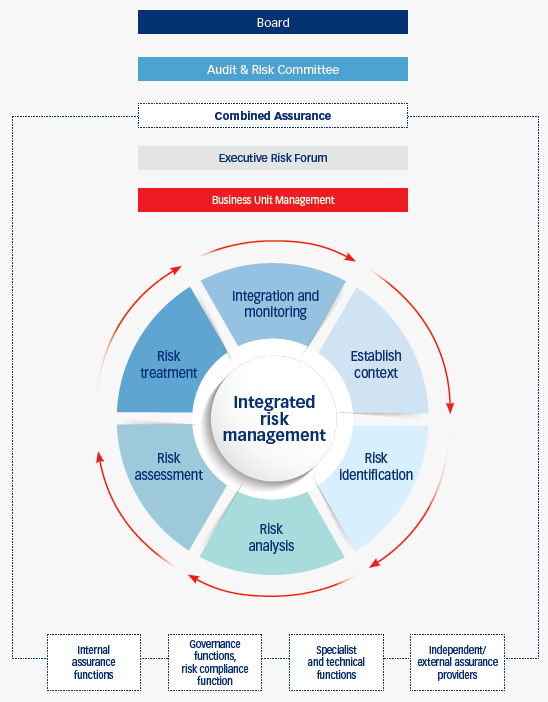
Risk management activities occur at all levels in the organisation. We strive to embed sound risk management in our strategy, planning, budgeting and performance management processes. Senior executives are accountable for performing risk effective risk management within their areas of responsibility and for promoting a culture of risk awareness throughout the organisation. The Group Risk Management Policy and the Risk Management Framework provides structure for these activities to be embedded into our key decision-making processes and day-to-day activities and achieves alignment with the Group’s risk appetite and tolerance levels. On a quarterly basis, the Group Risk function coordinates the completion and consolidation of risk assessments across the Group and undertakes activities to identify new and emerging risks. The Group risk profiles are discussed and reviewed regularly by the Executive Risk Forum (comprising senior Group Executives) and are assimilated into a Group Risk Report for consideration by the Audit & Risk Committee and the Board.
Risk governance
The Board is ultimately responsible for the Group’s approach to risk management and internal controls. It defines the Group’s risk appetite, enabling the Group to judge the level of risk it is prepared to take in achieving the Group’s strategic objectives. It has delegated oversight of the implementation of risk management to the Audit & Risk Committee. The Audit & Risk Committee reviews the material risks facing the Group and obtains assurance of the effectiveness of the risk management process and risk responses through the implementation of a combined assurance approach.
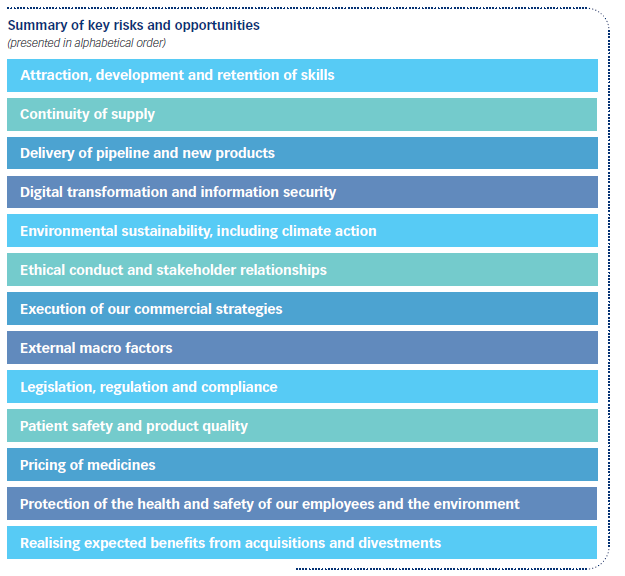
The key risks and opportunities that have a material impact on our ability to achieve our strategic objectives and create value are outlined in the table overleaf. In FY2021, we included a new standalone risk – Environmental sustainability – reflecting the increased expectation of stakeholders that companies understand and reduce environmental impacts across their supply chains. In the pages that follow, we provide further context, the opportunities presented for value creation and our high-level strategies to respond to these.
Uncertainty created by COVID-19
The COVID-19 pandemic has resulted in great uncertainty and many challenges for people and companies across the globe. Despite this, our business model has proved to be resilient. Our carefully tailored product portfolio, effective business continuity plans and the safety measures we took to protect our employees have enabled us to remain in full operation throughout this period. As was the case in the prior year, COVID-19 presented Aspen with opportunities to extend our contribution to the global health response by supplying critical medicines used in the treatment of patients infected by this disease. In addition to this, in 2021 we initiated the manufacture of the Johnson & Johnson COVID-19 vaccines. The broader impact of the pandemic (also refer to “Our external operating context”), however, also contributed to elevated levels of uncertainty across all aspects of the Group’s operations. Under the close direction of the Board, executives continue to monitor the situation, adapting our responses to minimise impacts on patients, customers and employees.
Risk context
We need a diverse and engaged pool of talented employees to execute the Group’s strategy in an increasingly complex and uncertain environment. There is fierce competition for the best talent, especially in certain technical and/or specialist fields and in certain of our operating regions. Accelerated by COVID-19, increased flexibility and new ways of working are emerging as key value drivers in attracting key talent. Employee engagement and retention can be impacted by organisational change and the resultant uncertainty.
Opportunity for value creation
A motivated and productive workforce enables a high performance culture, innovation and alignment to strategic goals. Through the development of a compelling employee value proposition, the Group seeks to position itself as an employer of choice in the competitive landscape.
Our response
Talent management is a key focus area in our human resources strategy and initiatives are being introduced to better define and understand our talent supply and demand requirements. Targeted programmes are being implemented to increase diversity and gender representation, accelerate development of high potential employees and increase employee readiness for future positions through focused skills development and enhanced behavioural awareness programmes. Change management initiatives are implemented in business units impacted by organisational changes.



Risk context
Our end-to-end value chains may be impacted by unplanned external interruptions, including non-availability of essential raw materials, utilities and services or closure of our manufacturing sites as a result of natural disasters, civil unrest, regulatory interventions, fire, extreme weather and pandemics. The technical and regulated nature of the manufacturing and supply of pharmaceuticals leads to a heightened inherent risk of quality failures which may result in batch rejection or product recalls (refer to Patient safety and product quality risk). We have a key reliance on certain specialised raw materials and third party manufacturers, and we rely on these parties to supply products within specification and required timeframes. We continue to be engaged in multiple projects to transfer the manufacture of certain products to new lines within our own facilities or to alternative production sites. These technical transfers offer access to Aspen’s more cost-effective and/or reliable manufacturing, but can pose execution risk.
Opportunity for value creation
We strive to maintain a reliable supply of medicines to our customers and to the patients that depend on them. Our ability to effectively manage the risks within our complex supply chain and to effectively respond when disruptions do occur is a key value driver which underpins our reputation as a responsible and reliable pharmaceutical company. Consistent availability of supply also allows us to take advantage of supply disruptions experienced in respect of competing products.
Our response
We build strong long-term relationships with API suppliers and third party manufacturers to ensure continuity and security of supply. Where appropriate, we manufacture our own API. Our strategy to invest in our sterile manufacturing capability in order to in-source the manufacturing of anaesthetics further increases our control over the supply chain. Skilled and experienced teams are involved in technical transfer projects and there is oversight by the Group operations division to ensure required milestones are achieved. Safety stock of raw materials and finished product is generally held to provide a buffer in the event of supply disruption. We are continually strengthening our systems and processes, as well as our business continuity plans, to allow for a coordinated response to supply disruptions. Appropriate insurance coverage is held for high-impact events.


Risk context
The identification, development and commercialisation of new products is both time-consuming and costly, involving a high degree of business risk. A project may fail or be delayed at any stage of the process due to a number of factors. As a result of the lengthy timeframes associated with new product development projects, the assumptions made at the initiation of these projects could change, impacting the planned return on investment. New products may not be accepted by the health regulator, may not perform as expected or may face greater-than-anticipated competition. Timing of new product launches is dependent on the speed of processing of the necessary registrations by the regulatory authorities in each country.
Opportunity for value creation
Products that are successfully launched from the pipeline represent opportunities to expand access to treatment options for healthcare providers and patients. A healthy pipeline is a key driver in our sustainable growth strategy, representing opportunities to leverage our investment in IP and manufacturing capability.
Our response
Our product portfolio management strategy focuses on the identification of opportunities that align with our business strategy, that leverage our intellectual and manufacturing advantage, and that align with the local market conditions in a broad geographic footprint. Through the implementation of product development lifecycle management, our regional business and Group product portfolio development teams continuously review and refine our pipeline, increasing the focus on molecules with confirmed commercial feasibility and enhanced value creation potential.

Risk context
Digital technologies continue to revolutionise the way companies conduct business. Keeping pace with the speed of digital transformation is imperative to remaining competitive and relevant, and it requires the adoption of an agile digital strategy, enabled by an investment in IT infrastructure, systems and capabilities. Large-scale IT projects are exposed to implementation risk. With the increasing incidence of cyber-attacks, there is an increasing need to ensure secure and reliable IT systems and infrastructure as well as the careful management of the information that is in our possession to ensure data privacy. Failure to adequately protect critical and sensitive systems and information may affect our ongoing business operations, resulting in the loss of commercial or strategic advantage or in a breach of data privacy regulations.
Opportunity for value creation
Digital technologies are an enabler in driving our strategic objectives forward and supporting sustainable operations. Increased digitisation provides opportunities for efficiency gains for improved collaboration internally and with our key partners, as well as for information-driven decision-making.
Our response
Our digital transformation has received increased focus, with an emphasis being placed on foundational areas that will position us for growth and optimisation, including governance, cyber security and risk management. We have continued to make a considerable investment in modernising our enterprise resource planning (“ERP”), regulatory and compliance systems and manufacturing execution systems, while digital platforms are being increasingly used to enhance communication and collaboration with our various stakeholders. Our data privacy policies ensure that we collect, transfer and store electronic and hard copy personal data appropriately. The Audit & Risk Committee provides oversight of Information & Technology (“I&T”).




Risk context
There is an increasing global focus from regulators, investors, healthcare providers, customers and the broader society for companies to implement measures needed to transition to a low-carbon economy. These transitional risks could include changes in the regulations in which we operate, including mechanisms implemented by governments to accelerate climate action, such as carbon taxes. Our customers and business partners may place an increasing weight on our environmental sustainability performance, and that of our value chain, in their purchasing decisions. Physical impacts from climate change could pose business continuity threats to our own operations and across the entire value chain.
Opportunity for value creation
Addressing the risks relating to environmental sustainability creates opportunity for reducing our carbon footprint while achieving increased efficiency in using scarce natural resources. It also builds resilience against physical impacts. Contributing to the broader issue of environmental stewardship creates the opportunity to build social capital and contribute towards healthier communities.
Our response
We have embarked on a process to better understand the potential impact of climate change on our business and we are committed to developing a climate action plan with related targets. We are equally committed to reducing our waste and water consumption. This will build on the environmental and resource efficiency initiatives we have already implemented to reduce our reliance on scarce resources and our impact on the environment. We support the Taskforce on Climate-related Disclosures and aim to develop our disclosures in line with its recommendations (refer to Natural capital).


Risk context
We understand that to be successful, we must conduct our operations ethically and in a way that meets the expectations of our wide range of stakeholders. Poor ethical behaviour or a failure to subscribe to our values or our Code of Conduct could potentially result in the loss of trust by stakeholders and reputational damage.
Opportunity for value creation
Maintaining a corporate culture which is underpinned by ethical decision-making and conduct is fundamental to building trust with our various stakeholders and enhances our corporate reputation.
Our response
We have a zero-tolerance approach to unethical behaviour. Our Code of Conduct is a values-based code aimed at governing the conduct of our employees. A formalised ethics management programme has been implemented and the effectiveness of this programme is overseen by the Social & Ethics Committee. Our approach to stakeholder relationship management entails identifying and engaging transparently on issues that may impact our commitment to practising good corporate citizenship.

Risk context
There are a number of risks that could impact the development and execution of our commercial strategies. Increased competition, the introduction of new treatment regimes, fluctuations in demand due to pandemics, changes in health policies, the introduction of new pricing policies, volatile market environments, commercial team performance and availability of supply are just some of the factors that could impact the achievement of expected performance. If commercial performance does not succeed as anticipated, increased pressure is placed on financial sustainability. Sustained deterioration in the commercial performance of specific products may result in an impairment in IP.
Opportunity for value creation
The ability to achieve our commercial performance expectations underpins the strategy of the Group to create sustainable long-term value for all of our stakeholders.
Our response
We continue to reshape our product portfolio to achieve an appropriately balanced and diversified basket of Sterile Focus and Regional Brands, with a focus on niche specialty brands where we perceive opportunities to be better. We continually invest in our commercial team structures, processes and skills as well as seeking mutually beneficial collaboration arrangements.



Risk context
We are a multinational Group and therefore exposed to various geopolitical, social and economic risks that may potentially impact our operations. These risks are complex and constantly evolving, creating an uncertain environment in which to do business. While many territories present opportunities, these macro factors can create impediments to potential growth such as policy uncertainty, restrictions on access to funds, currency volatility, rising interest rates, social unrest and increased inflationary effects. Also refer to Our external operating context.
Opportunity for value creation
The ability to effectively navigate the dynamic and uncertain market environments creates opportunity to achieve growth, enhanced returns and further diversification.
Our response
Our diverse geographical footprint provides some mitigation to localised macro factors. We continuously monitor socio-economic trends and geopolitical events in countries where we operate and response strategies are implemented where required.


Risk context
The pharmaceutical industry is subject to extensive, complex, costly and evolving regulations governing the approval, manufacturing, labelling, marketing and sale of pharmaceutical products. These regulations vary by region and country and are rigorously monitored and enforced. All other aspects of our business are subject to extensive legislation and regulation, which increases in complexity due to the multinational nature of our business operations. Changes in these laws and regulations can significantly impact our operations or increase the risk of non-compliance.
Opportunity for value creation
Maintaining compliance with relevant laws, regulations and standards forms an essential part of our licence to operate and is fundamental to our commitment to being a responsible corporate citizen.
Our response
Our business behaviour is underpinned by a strong ethical drive to always do what is right and ensure that the necessary ethics and legislative compliance management processes are in place, having developed a robust regulatory and compliance management framework across the Group’s operations. Legislative and regulatory developments are monitored on an ongoing basis. Internal communication and training on the ethics standards expected from each employee is performed while the key regulatory and compliance requirements are assessed on a regular basis. Legal and regulatory compliance is monitored by Group executives and the Board.


Risk context
Our products, most of which are prescription medicines, are used by a multitude of patients in a vast number of countries. We have the responsibility to implement appropriate pharmacovigilance procedures and systems to identify, investigate and resolve any potential safety concern relating to these products. The quality requirements for pharmaceuticals are rigorous across the entire supply chain and include standards that are applicable to suppliers, manufacturing and distribution. The highly complex technical manufacturing processes associated with our products increases the inherent risk of quality deviations and batch rejection.
Opportunity for value creation
Our overriding responsibility is to the patients who use our products, the HCPs who prescribe them and the regulators who protect public health. Our ability to provide a reliable supply of safe and effective medicines, and effectively respond to safety or quality incidents as and when they occur, underpins the trust these stakeholders have in the Aspen brand.
Our response
Our Group Pharmacovigilance function, supported by local business units globally, is responsible for monitoring and managing the safety of all our products throughout the product lifecycle using robust systems and processes to monitor manufacturing quality standards, compliance with current GMP and other regulatory requirements. Our Quality Assurance department conduct audits to support the achievement of our high quality standards. Our responsibility to our patients and consumers is monitored by the Social & Ethics Committee. The Group holds the appropriate product liability insurance.

Risk context
There is a heightened focus on rising healthcare costs and scrutiny by the healthcare payers in respect of the pricing of pharmaceuticals across the world. Many governments have implemented programmes to control the pricing of pharmaceuticals which may include setting the price for pharmaceuticals, legislating price cuts and introducing programmes to increase the use of generics. The governments of the countries in which we operate may, in future, implement further regulations that impose additional pressure on the price of pharmaceutical products. In emerging markets, governments are increasingly controlling pricing and introducing price referencing. Such changes impose increased pressure on margins and impact our financial performance. Also refer to Our external operating context.
Opportunity for value creation
Access to affordable healthcare is a global challenge. Through active engagement with healthcare providers, payers and regulators, we aim to implement responsible pricing strategies that achieve the appropriate balance between making our products affordable, while achieving reasonable returns on investments made.
Our response
To manage pricing pressure, we engage actively with regulatory authorities and other key stakeholders on regulatory/pricing issues that affect the industry. The pricing mechanisms in each country are monitored and adjustments are made to the business model and/or product portfolio as necessary to maintain overall profitability in an ethical, responsible and compliant manner. By continuing to invest in our own manufacturing capacity and capabilities, and by implementing process improvement initiatives, efficiencies and synergies are also unlocked to protect profit margins in this restrictive and regulated pricing environment.

Risk context
The pharmaceutical and chemical manufacturing industries present inherent health and safety risks to our employees and contractors who perform work on our sites. Our manufacturing processes involve the use of chemicals and include hazardous or toxic materials, increasing the risk of environmental contamination. Our operations are reliant on the consumption of scarce natural resources and result in negative impacts on the environment such as carbon emissions and waste. As the provider of essential medicines, our manufacturing sites remain operational during communicable disease outbreaks, increasing risk to our employees. Continuous focus is required to achieve compliance with the environmental, health and safety laws, as well as with regulatory enforcement in the various territories in which we operate.
Opportunity for value creation
Maintaining a safe and healthy working environment for our people and minimising the impact that our activities have on the environment in which we operate are strategic imperatives which underpin our commitment to being a responsible corporate citizen.
Our response
We have implemented the Group’s safety, health and environment (“SHE”) programme, aligning our health and safety management systems to global standards, with all of our fully commercialised primary manufacturing sites and API sites holding the ISO 45001 standard certification. Our SHE performance is monitored by the Social & Ethics Committee.

Risk context
An integral component of our strategy is achieved through acquisition, licensing, collaboration and divestment transactions. The risk in respect of acquisitions is that the Group may fail to identify suitable acquisition opportunities or realise the expected benefits of the acquisitions, or may incur unexpected risks and obligations because of the transaction. The success of the Group’s acquisition strategy is dependent, among other things, on the successful integration of the technologies, products and businesses it acquires, and their subsequent growth. The Group may decide to dispose of assets that are no longer deemed core. When disposing of assets, the Group may not be able to complete the disposal on terms deemed acceptable, may be required to give guarantees and warranties, or may expose itself to claims from purchasers, as well as creditors of the transferred business.
Opportunity for value creation
Through successful portfolio management, we are able to meet the medical needs of patients, build focused therapeutic portfolios, achieve a desired geographical footprint and leverage our manufacturing and supply chain capabilities. Transactions are key to our Portfolio Management Model, to provide the opportunity to accelerate strategy and to achieve accretive growth in the overall economic value of the Group.
Our response
We perform extensive due diligence to strategically identify, value and execute transactions. External specialists are involved where required. Transactions are negotiated by experienced and highly skilled professionals. We have an established approvals framework and proposed transactions are critically reviewed by executive management, and where required, approved by the Board. We have dedicated integration teams to execute defined transition agreements to ensure a successful transfer of processes and product distribution. Post-acquisition performance is monitored closely to ensure integration and delivery on business plans.