


Our strategic business performance
A high-level overview of our performance over the past year and the outlook for each of our strategic objectives are set out in the pages that follow.
Strategic objective

To deliver a differentiated portfolio of high quality and affordable medicines
Performance highlights
Contributed to the global response to the COVID-19 pandemic through the supply of life saving medicines and treatments.
Successfully commenced production of the Johnson & Johnson COVID-19 vaccine, contributing to the global response in ensuring vaccine accessibility.
Completed the strategic review of our Commercial business with the divestment of the European thrombosis portfolio, creating a commercial platform with a strong weighting towards growth territories.
Continued the targeted approach to product development and licensing initiatives creating a product pipeline aligned with the Group’s future growth plans, successfully launching a total of 40 products in 17 countries and territories, broadening access to high quality, affordable medicines and products.
Maintained a strong quality culture achieving positive results from inspections undertaken by regulators and audits conducted by customers.
Reduced further already low level of product recalls.

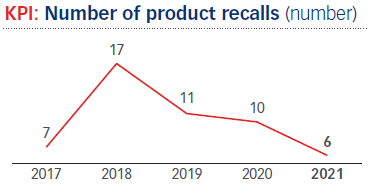
The number of product recalls has reached a five-year low following the marked increase experienced in FY2018, where we transitioned the anaesthetic supply chain. Four of the six recalls related to packaging and labelling issues, while all were limited to batch-specific issues requiring recall of the affected batches only.
Challenges experienced
- COVID-19 negatively impacted the demand for some of our products as elective surgeries have been postponed, social distancing lowered the spread of certain communicable diseases and in general, people reduced visits to doctors and pharmacies.
- Instances of supply delays and disruptions, together with spikes in demand as a result of COVID-19, required careful stock allocation and prioritisation to minimise the impact of supply shortages.
- The timing of new product launches is dependent on meeting regulatory requirements and the speed of processing of the necessary registrations by the regulatory authorities in each country. These processes were impacted by the pandemic as regulatory bodies reprioritised their restricted resources to COVID-19-related matters.
- Increasing complexity of regulatory requirements and product regulations, requiring additional resources to maintain and upgrade our IP.
Near- to medium-term outlook
- A successful outcome in our discussions with Johnson & Johnson to obtain COVID-19 vaccine licence for Africa would make a meaningful contribution to our endeavours to increase access to medicines, particularly in our home continent of Africa.
- Further delivery against Commercial pharmaceuticals growth objectives.
- The initiative of South African Health Products Regulatory Agency (“SAHPRA”) to expedite the backlog of registrations is expected to accelerate the unlocking of further value from our pipeline.
- Development and refinement of the product pipeline in line with the Group’s targeted therapeutic categories for each region is being pursued in order to build on the areas of expertise which we have developed and reduce exposure to pricing risks.
- Sales structures will be assessed on an ongoing basis to ensure that we are delivering the appropriate services to meet the demands of healthcare providers.
- Ongoing consideration of collaboration and partnering opportunities to achieve enhanced distribution capability in territories where we lack sufficient critical mass.
- The gearing capacity that has been created provides headroom to pursue any new strategic investment opportunities which are identified as value enhancing for the Group.
Key risks and opportunities
- Relevant product portfolio able to support COVID-19 treatment initiatives
- Continuity of supply
- Delivery of pipeline and new products
- Digital transformation and information security
- Execution of our commercial strategies
- External macro factors
- Legislation, regulation and compliance
- Patient safety and product quality
- Pricing of medicines
Strategic objective

To optimise the strategic advantage of our integrated value chain
Performance highlights
For the full 12 months, maintained a consistent and reliable supply of medicines and products globally despite the ongoing disruption caused by COVID-19.
Fast-tracked technical transfer and commenced the production of COVID-19 vaccines for Johnson & Johnson at our Gqeberha manufacturing site in South Africa.
Progressed the significant capital projects at the Gqeberha site in South Africa, the Notre Dame de Bondeville site in France and the Bad Oldesloe site in Germany aimed at increasing capacity and capability for the transition of the manufacture of a significant portion of our anaesthetics portfolio to our own facilities over the next three years. Commercial production of certain anaesthetics products commenced.
Continued to implement changes required to meet serialisation regulations at our manufacturing sites.
Progressed with the mitigation of electricity and water availability risks at our South African manufacturing sites.
Progressed the strategic project to optimise our end-to-end value chain through an integrated business planning process.
Continued investment in ERP systems and processes to enhance the integration of manufacturing and finance processes and systems, achieving increased efficiency and the ability to manage risks across the complex supply chain more effectively.
Transformational organisational design and process improvement initiatives, initiated at certain API and FDF production sites identified opportunities for increased efficiency and cost reduction.
Currency volatility impacts the cost of goods across the supply network, and since many of our APIs are purchased in USD, the weakening of the USD against a number of the currencies in which we trade resulted in some upside over this period.
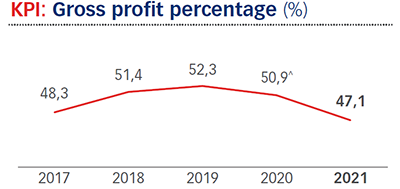
^ Restated for discontinued operations.
The lower gross profit percentage is driven predominantly by the higher proportion of Manufacturing sales to total Group sales at a lower gross profit percentage strongly influenced by the FDF form transaction-related supply and the higher costs of production under COVID-19 conditions.
Challenges experienced
- COVID-19 continued to create a challenging operating environment, increasing health and safety protocols at sites, as well as employee absenteeism. Outbreaks of the virus also created instances of delays in the supply of API, changes to production schedules required to meet fluctuations in demand and also constrained shipping channels. These are all factors that impacted costs and productivity levels.
- The pharmaceutical supply chain is complex, and matching supply with demand in multiple territories remains a focus area for the Group.
- Lockdown measures and travel restrictions resulted in delays in the capital expansion projects.
- Increases in the price of heparin resulted in a higher cost of goods sold for thrombosis brands.
- The supply agreements linked to the recent disposal transactions at a low to no margin negatively impacted margin contribution and increased the mix contribution of the Manufacturing segment.
Near- to medium-term outlook
- The consolidation of anaesthetics manufacturing into Aspen sites will further increase our control over the supply chain, enhancing security of supply and thereby allowing better access to these essential medicines. It will also lead to lower cost of goods, allowing access to more competitively priced commercial opportunities.
- The ongoing production of the COVID-19 vaccines at our Gqeberha site in South Africa, with potential for increased production volumes on a contract or licensed basis, will contribute positively to utilisation of sterile manufacturing capacity and improved contribution from Manufacturing.
- Conversion of existing vial capacity to include vaccine capabilities provides further opportunities for supporting vaccine demand.
- The strategy to source sustainable third party volumes to utilise surplus capacity within our manufacturing facilities is expected to have incremental commercial benefits with the additional potential to unlock further partnership opportunities with multinationals.
- The process improvement initiatives underway at some of our key sites are expected to yield considerable efficiency gains.
- Our integrated supply chain and niche manufacturing capabilities, matched with our global distribution capabilities, places us in a position to enter into value-creating partnerships.
- The significant investment in digital transformation initiatives is expected to increase overall value chain efficiency
Key risks and opportunities
- Continuity of supply
- Digital transformation and information security.
- External macro factors.
- Legislation, regulation and compliance.
- External macro factors
- Legislation, regulation and compliance
- Patient safety and product quality
Strategic objective

To develop and retain a talented, agile and diverse workforce inspired to achieve operational excellence
Performance highlights
Prioritised the health, safety and wellness of our employees while remaining productive and engaged throughout the COVID-19 disruption.
Further progressed the implementation of our global human resources strategy, with the global equity, diversity and inclusion framework receiving heightened strategic focus during the year.
Demonstrated commitment to gender equity through becoming a signatory to the United Nations Women Empowerment Principles.
Completed a number of organisational redesign projects.
Extended the implementation of the Global Learning Management System to further businesses.
In South Africa, provided a total of 148 learners/apprentices with funding during the year, and provided 51 bursaries to employees to further their formal education.
Continued efforts aimed at the targeted restructuring of the workforce in selected operations to achieve required operational efficiency.
Implemented a Group universal incentive scheme aimed at achieving alignment between the Group, business units and individuals in setting, measuring and achieving performance objectives.
Maintained our historically high safety standards with zero incidents of occupational fatalities and a significantly lower TRIFR.
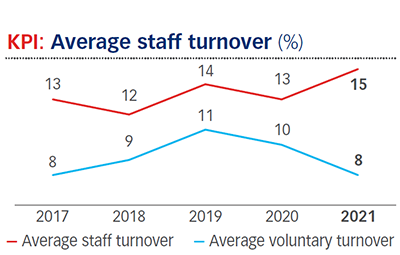
Overall staff turnover has trended upwards reflecting the impact of targeted restructuring activities undertaken within the Group. Voluntary turnover has declined indicating a more stable work environment in a number of the Group’s business units.
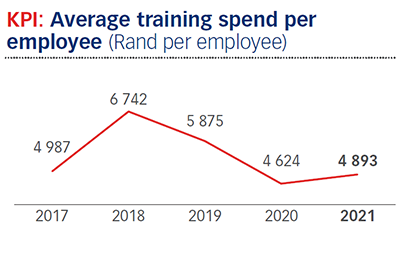
Training spend has gained some momentum in FY2021, but remains negatively impacted by restrictions in travel and face-to-face gatherings imposed during COVID-19.
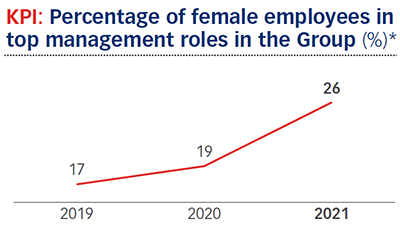
The representation of women in the senior positions in the Group has increased to 26% as efforts continue to advance women within the organisational structure.
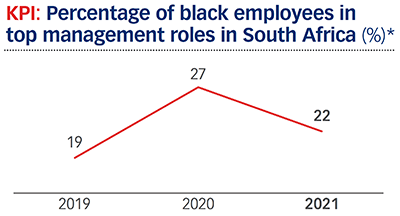
The percentage of black employees in the top management roles in South Africa has been impacted by restructuring activities and has declined to 22%.
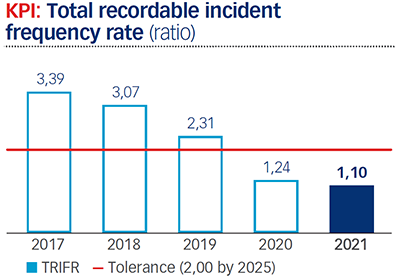
The TRIFR has reduced to below the tolerance level indicating an improved health and safety culture. No occupational fatalities were recorded. Despite the improvement, the investigation, analysis and remediation of all incidents remains a focal point in order to prevent recurrence.
* These KPIs were only measured from 2019 and therefore no prior comparatives are available.
Challenges experienced
- The ability to attract, retain and develop the diverse talent and specialist technical skills required to support the increasing complexity of the Group remains a focus area.
- The implementation of certain training and development interventions was negatively impacted by COVID-19.
- Maintaining the health, safety and general well-being of our employees during the COVID-19 pandemic while rapidly deploying new ways of working.
- The inherent health and safety risks relating to the pharmaceutical and chemical industry require an unwavering focus on maintaining a strong safety culture across all of our operations.
Near- to medium-term outlook
- The continued implementation of the global human resources strategy will further progress our objective to create an engaging, enabling and inclusive environment for all of our employees.
- Organisational redesign projects are underway to position the Group for increased effectiveness.
- The drive to improve the representation of women and, in South Africa specifically, racial diversity in key management levels remains a focus in the medium term.
- Initiatives to further enhance the safety culture across our operations continue to receive attention.
Key risks and opportunities
- Attraction, development and retention of skills.
- Digital transformation and information security.
- Ethical conduct and stakeholder relationships.
- Legislation, regulation and compliance.
- Protection of the health and safety of our employees and the environment.
Strategic objective

To be a good corporate citizen by conducting our business in a responsible, inclusive and sustainable way
Performance highlights
Actively supported efforts to respond to the COVID-19 pandemic.
Retained our inclusion in the Top 30 FTSE/JSE Responsible Investment Index and FTSE4Good Index Series.
Maintained our support of the UN Global Compact, the CDP-CC and CDP-WS initiatives.
Aspen’s ethics culture in 17 major businesses across the Group was independently assessed by The Ethics Institute as advanced (85th percentile).
Continued to focus on targeted transformation initiatives in the South African business and the achievement of BBBEE objectives.
Continued our support of SED projects contributing to the well-being of the communities in which we do business.
Reached agreement with the European Commission, successfully closing its investigations into certain pricing matters.
Reduced total carbon emissions, waste generated, water withdrawn and electricity used.
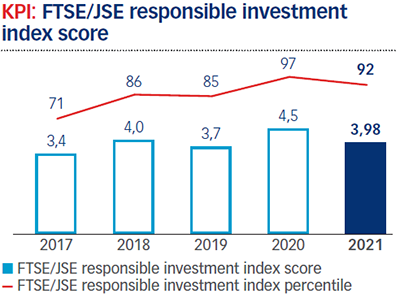
Our score on the FTSE/JSE Responsible Investment Index reduced to 3,9 reflecting the introduction of specific criteria relating to climate action and targets within the scoring methodology. Despite this reduction, we remain above the 90th percentile in the Health Care peer sector group and we have retained our inclusion in the top 30 FTSE/JSE Responsible Investment Index and FTSE4Good Index.
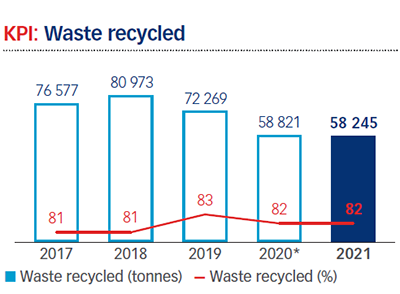
* Restated.
Total waste generated and the percentage of waste recycled remained flat year-on-year. Approximately 1% of waste generated is diverted to landfill.
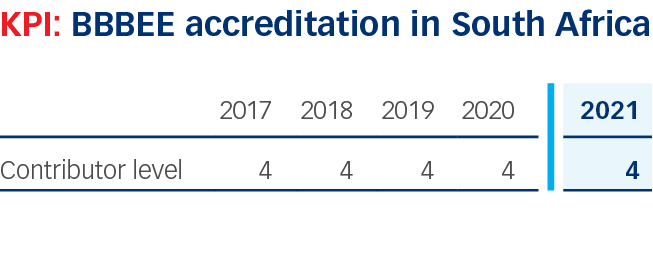
Through executing a focused BBBEE strategy, we have retained our contributor level at Level 4.

There has been a further 9% reduction in the volume of water withdrawn as water conservation projects continue to yield favourable results.
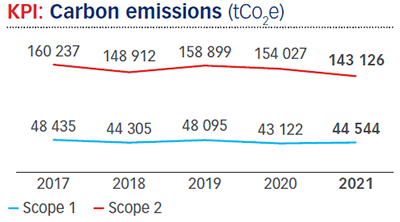
Total carbon emissions have decreased with increases in Scope 1 emissions, driven by increased production at Gqeberha, being offset by lower energy consumption arising from continuous improvement projects.
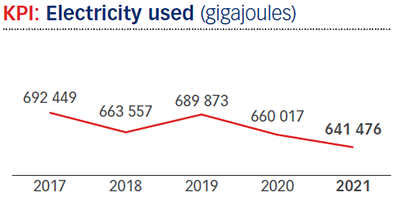
Electricity consumption decreased by a further 2,8% in FY2021 as energy improvement projects continue to be implemented at sites.
Challenges experienced
- Stakeholder expectations, reporting and disclosure requirements in respect of our corporate citizenship and sustainability commitments continue to increase and require ongoing attention to ensure we continue meeting these in a balanced and responsible manner.
- Our operations span multiple territories, with complex regulatory frameworks requiring ongoing vigilance to reduce the risk of non-compliance.
Near- to medium-term outlook
- Ongoing emphasis will be placed on ensuring an ethical and values-driven culture throughout the Group.
- Continued investment in appropriate skills development and enterprise development initiatives as well as a focus on preferential procurement to further improve our BBBEE performance.
- In line with a revised Group SED policy, projects aligned to specific objectives will be continued in the countries in which we do business.
- Areas for improvement flagged in the ethics culture assessment performed by The Ethics Institute will be incorporated into the Group’s ethics and compliance programmes and processes.
- A climate change strategy is being developed for the Group aimed at addressing climate change risks.
- The recalibration of our sustainability strategy and alignment of our ESG priorities is underway to meet increasing expectations of our various stakeholders.
Key risks and opportunities
- Environmental sustainability, including climate action.
- Ethical conduct and stakeholder relationships.
- Legislation, regulation and compliance.
- Protection of the health and safety of our employees and the environment.
Strategic objective

To create sustainable economic value for our stakeholders
Performance highlights
Created R16 492 million in value, with R7 538 million being paid to employees, the generation of R1 380 million in revenue for governments, R22 481 million in payments to providers of goods and services and R19 million to support various SED initiatives.
Achieved double-digit organic revenue growth, with Commercial Pharmaceuticals revenue up 6% (+4% CER) and Manufacturing advancing 36% (+29% CER).
Tight controls implemented over operating expenses contributed positively to EBITDA margins.
Completed the divestment of the assets of the European Thrombosis business in line with our stated strategy to bring greater focus to the Commercial Pharmaceutical business. This transaction realised net cash inflow in FY2021 of R12 351 million (before tax) and contributed notably to the deleveraging of the Group.
Achieved strong operating cash flows, realising a cash flow conversion ratio of 134%.
Strong operating cash flows and net proceeds on divestments was used to accelerate deleveraging of the balance sheet, achieving a leverage ratio of 1,74 times at financial year end, with substantial headroom on covenant level of 3,5 times.
Dividend reinstated and declared at 262 cents per share.
Secured a joint financing package of EUR600 million from a consortium of development finance institutions to be used to refinance a portion of existing EUR-denominated syndicated debt facilities.
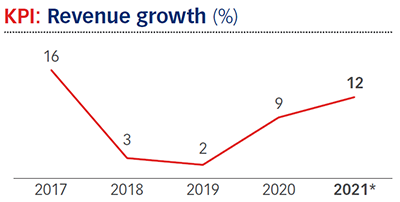
Reported revenue growth of 12,0% was underpinned by solid organic growth in the Commercial Pharmaceuticals segment (+6%) and Manufacturing segment (+36%) boosted by COVID-19 vaccine supply as well as FDF transaction-related revenue.
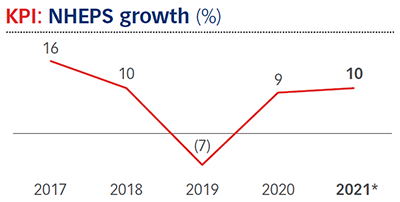
Reported NHEPS growth of 10% has benefitted from the reduction in net finance costs of 29% in the current year.
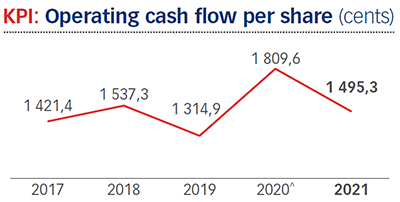
The discontinued businesses have impacted the absolute cash flow values, but operating cash flow conversion rate remains extremely strong at 134%, well above the internal target of 100%.
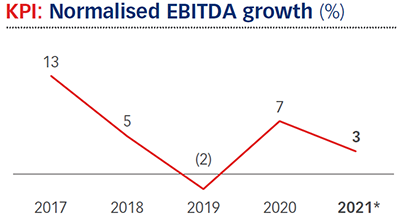
The reported growth in normalised EBITDA of 3% has been affected by the lower gross margin percentage of the Manufacturing segment, which also increased its percentage contribution to revenue and reduced other operating income.

The reduction in the normalised EBITDA margin percentage is due to the dilutive effect of the increased mix of lower margin Manufacturing revenue partially offset by well-controlled operating expenses.
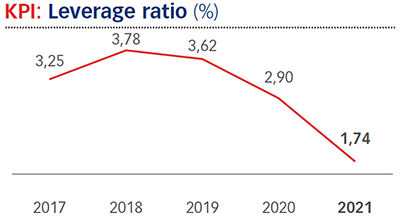
Positive cash flows and proceeds on the disposal of the assets of the European Thrombosis business have enabled the reduction of net borrowings, reducing the leverage ratio to comfortably within the covenant level of 3,5 times.
* Growth calculated on 2020 restated figure for discontinued operations.
^ Restated for discontinued operations.
Challenges experienced
- Sales in certain product segments negatively impacted by COVID-19.
- Oncology price reductions have had an unfavourable impact on Commercial Pharmaceuticals revenue and gross profit in the Europe CIS region.
- Ongoing downward pressure on selling prices.
- Increasing costs of doing business under COVID-19.
- Evolving pharmaceutical regulations and application of increasingly stringent quality standards has led to raised costs of compliance across all territories. The high cost of doing business in this complex regulatory environment places pressure on achieving satisfactory returns on investment.
Near- to medium-term outlook
- The completion of the strategic review of the European CIS business is expected to deliver improved results.
- Product launches from our focused product pipeline provides further potential for growth.
- Continued focus on initiatives aimed at reducing operating costs and driving production efficiency.
- The transition of anaesthetics production to our own facilities expected to generate reductions in costs of goods.
- Vaccine roll-out will gather momentum as FY2021 only included four months of sales.
- Further revenue generation potential through additional Sterile Manufacturing capacity that will come on line.
- Our favourable relationships with many multinational pharmaceutical companies positions us to engage with them regarding collaborations and mutually beneficial transactions.
- Overall, the business is well positioned to continue positive FY2021 momentum, with further upside potential from the end of COVID-19-specific costs.
Key risks and opportunities
- Capital structure and debt obligations.
- Delivery of pipeline and new products.
- Digital transformation and information security.
- Execution of our commercial strategies.
- External macro factors.
- Legislation, regulation and compliance.
- Pricing of medicines.
- Realising the expected benefits from acquisitions and divestments.