



Financial capital

Inputs
- Pool of funds available to Aspen through shareholders' equity and debt funding
- Cash flow generation capabilities
- Reserves
- Financial internal control framework
- Financial and tax reporting systems
Key initiatives
- Maintenance of strict financial discipline and controls
- Deciding on deployment of available capital
- Measurement of financial performance, value creation and cash generation
- Active engagement with providers of capital and debt funding
- Seeking out investment opportunities to increase revenue generation, profitability and shareholder returns
- Focus on organic growth
- Generation of synergistic benefits from acquired businesses
- Focus on working capital management
- Focus on increased tax reporting requirements and tax transparency
Outcomes
- Economic value creation for Aspen's stakeholders, including its shareholders, employees, customers, providers of capital, governments and business partners
- Distributions to shareholders
- Delivered a CAGR of 23% in returns to shareholders from listing until 30 June 2021
- CAGR in excess of 28% for revenue, normalised EBITDA and NHEPS since listing
- Funding opportunities at competitive rates
- Strong operating cash generation, enabling strategic deployment
- Transparent tax policies, principles and reporting systems
Value created for stakeholders

- Sustainable returns to shareholders
- Servicing and repayment of debt
- Economic stimulus through procurement of goods and services
- Contribution to governments through taxes
Material sustainability topics covered in this section:
- Creating economic value for stakeholders

Adding economic value to stakeholders
While the provision of high quality, affordable medicines and products benefits patients and consumers directly, a focus on building a profitable and sustainable business model generates economic value for our varied stakeholder groups. The Deputy Group Chief Executive's Financial Review, provides an overview of our financial performance for the year.
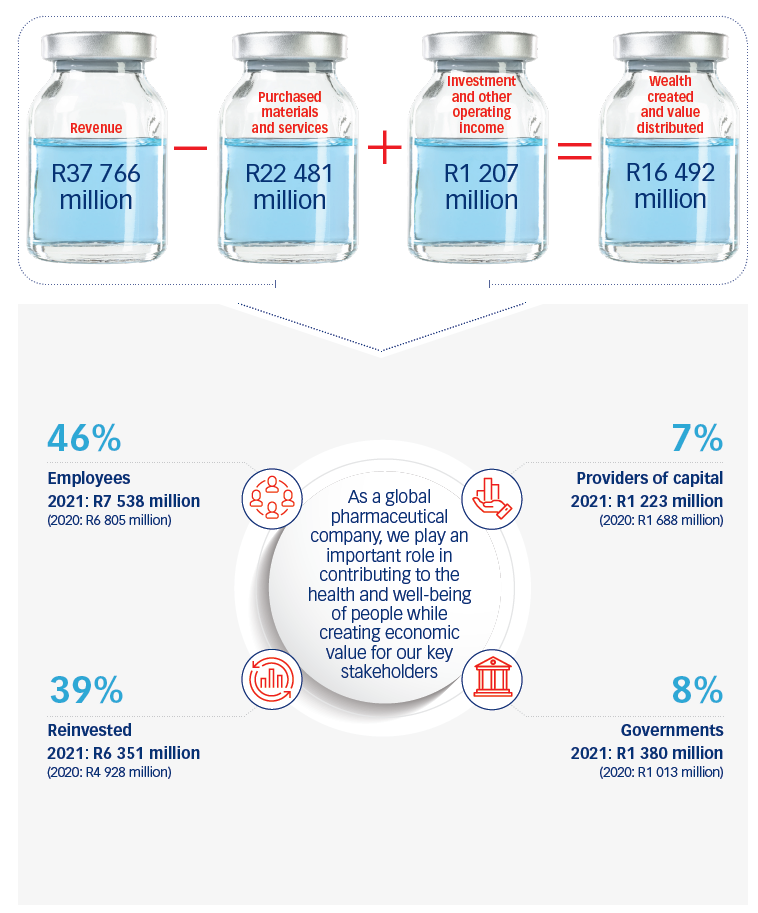
Our activities this year have created R16 492 million in wealth. This is calculated after taking into account R22 481 million spent on purchasing materials and services which contributed to the sustainability of our suppliers in the various economies in which we operate. Our employees receive the largest share of the total value distribution (46%) while a significant portion (39%) is reinvested in the Group to fund growth and expansion. Our gross economic contribution in the form of direct tax, paid to central and local governments in the countries in which we operate, amounted to R1 380 million. The Group value added statement is published in the Sustainability and ESG Data Supplement  online.
Maintenance of financial health
To sustain our business model and to generate accretive value for investors, we have a fiduciary duty to our stakeholders to manage our financial capital in a responsible manner. Robust financial controls and treasury management systems are in place to mitigate currency, interest rate and credit risks as far as reasonably possible. The Audit & Risk Committee assists the Board in discharging its duties in respect of the safeguarding of assets, accounting systems and practices, internal control processes and the preparation of the Group and Company Annual Financial Statements.
Internal financial controls
The key internal financial controls in operation for all significant operating businesses within the Group are documented in formalised financial internal control frameworks, and these frameworks are maintained and updated by financial management during the course of the year or as part of the year-end process. The documented key internal financial controls are audited by Group Internal Audit on an annual basis. This process provides support for the positively worded statement corroborating that there are no material breakdowns in the internal controls underpinning the financial results.
The Group also undertakes a rigorous self-assessment process, with the scope including all subsidiaries. The self-assessment review is formally signed off by the financial head of each subsidiary as is also reviewed and approved by the Group finance team. The self-assessment includes financial and disclosure controls, internal financial and operating controls, business performance-related representations and a detailed fraud assessment review. The positive assurance outcome provides strong support for meeting the requirements of section 3.84(k) of the JSE Listings Requirements.
Funding and treasury risk management
The Group Treasury Committee ("GTCo") is charged with monitoring the Group's performance in managing the risks (including liquidity, foreign exchange, covenant compliance, counterparty and interest rate) identified in the Group treasury policy. Local management is empowered, within the relevant approvals frameworks and the limitations set out in the Group treasury policy, to make decisions regarding how to manage these risks and to take ownership for implementation of any related actions. The GTCo is also responsible for overseeing, reviewing and challenging the recommendations made and actions taken by Group Treasury in terms of its duties under the Group treasury policy, as well as with respect to centralisation, automation and optimisation of the Group's operational treasury activities and the appropriateness of the Group's debt funding portfolio (including related intra-group guarantees and funding arrangements).
Capital allocation
Our capital allocation decisions are integrated into our strategy and budget planning processes, driven by our overall objective of growing shareholder value sustainably. Key considerations driving our capital allocation include achieving an effective allocation between maintaining our intellectual and manufacturing assets to secure operational returns, protecting the strength of our balance sheet to give us stability and flexibility through business cycles, investing in value-based organic and inorganic growth opportunities and rewarding our shareholders though dividends and/or share buy-back programmes. The Board provides oversight of capital and budget allocations, ensuring the most effective deployment of available capital resources.
Financial value we create
Approach to taxation
We have subsidiaries, branches, permanent establishments and joint venture arrangements in 56 countries around the world, predominantly in emerging markets. These entities are subject to the tax legislation of the countries in which they are domiciled. In addition, the countries in which the Group operates have all committed to implementing the OECD Base Erosion and Profit Shifting ("BEPS") recommendations, as they have all become members of the OECD's Inclusive Framework for BEPS. These recommendations include certain indirect taxes, international tax, domestic anti-avoidance provisions and transfer pricing. Domestic tax laws, including those dealing with international taxation, transfer pricing laws and enhanced transfer pricing documentation standards, have been amended to incorporate the outcome of the BEPS project. In addition, Aspen has seen an increase in value added tax ("VAT") reporting obligations, as more countries implement real-time reporting of transactions that are subject to VAT (collectively, "Domestic Law").
Our tax team is enhancing existing systems, implementing new tax reporting systems and working with our business units to tax sensitise the information that is being processed in our ERP systems to meet the increasing reporting requirements.
Our tax team is also required to:
- proactively monitor changes in Domestic Law and regulations published to interpret that law;
- ensure that the Group operates within these Domestic Law provisions and regulations;
- provide proactive advice to management and ensure that risks are identified in advance; and
- issue the new transfer pricing documentation reflecting both the OECD and the domestic tax law requirements, with the support of management of each entity.
The tax team undertakes this work under the guidance of the Group Executive: Tax, who reports those activities to the Group Tax Committee, which comprises the Deputy Group Chief Executive, the Group Finance Officer, the Group Strategic Development Officer, the Group Finance Executive: International Regions, the Group Finance Executive: Manufacturing, the Chief Financial Officer for Aspen Global, the Group Executive: Tax and at least one representative of Aspen's chosen tax adviser.
The Group Executive: Tax is also charged with the responsibility of designing, implementing and maintaining a tax risk management framework for the Group which is aligned to Aspen's overall strategy and risk appetite. The tax risk management framework is based on the philosophy that the Group applies a risk-based approach to tax matters and that all of its tax affairs are proactively managed.
The Group Executive: Tax is a standing attendee at the Audit & Risk Committee meetings and reports on the Group's affairs to that committee. In addition, reports are issued to the Board as decided upon by the Tax Committee or as requested by the Board.
Our tax strategy
Our strategic approach to taxes is to:
- implement systems and policies that provide for sustainable tax positions for each Group entity and that are compliant with the tax laws of the country in which each Group entity operates;
- engage with tax authorities with honesty and integrity in the spirit of cooperative compliance;
- identify and manage tax risks, ensuring that appropriate provisions are raised in relation to identified risks;
- ensure that the business objectives are met in a tax compliant manner;
- remain up to date with taxation laws, regulations and trends to ensure that the Group's business objectives remain tax-compliant; and
- act responsibly with regards to tax positions taken, ensuring that the Group's reputation is not negatively impacted by those positions.
Our tax risk appetite
Decisions on where our businesses are to be located are based on the Group's strategy and the commercial viability of doing so, taking into consideration the Group's need to support our customer base, the location of our investments in specialised manufacturing facilities and the availability of appropriately skilled people who contribute to the overall value chain. Although certain of the Group's entities are located in low tax jurisdictions (as defined by the OECD), these principles are applied consistently and without consideration of the potential tax benefit that may accrue to the Group. When we enter into transactions, the tax laws that affect that transaction are strictly applied within the context of the commercial requirements.
We are particularly risk aware in relation to our transfer pricing strategy. Our strategy is aligned to the OECD Transfer Pricing Guidelines and follows the arm's length principle, unless another principle has precedence under Domestic Law. For example, Brazil does not follow the arm's length principle but follows a formulary approach to determine the transfer price for transactions. The Group follows the Brazilian method in relation to transactions that are entered into between its Brazilian operations and other members of the Group. This is balanced against the arm's length principle that is applied by the company that is a counterparty to the transaction. The Group is currently monitoring developments in Brazil as that country significantly modifies its tax system generally, and more specifically in relation to transfer pricing.
We are conservative in determining transfer prices by applying margins that are aligned to those expected by tax authorities in relation to both parties to the transaction. In addition, we do not hold any IP in companies that do not actively participate in the value chain. Transfer pricing principles are implemented in a consistent manner by all Group companies.
Our tax compliance
We strive to submit all tax returns and other relevant forms and documents as they fall due, fully disclosing all necessary information that would be required by a tax authority to make an informed decision in relation to the tax positions that are taken in the tax return.
The Group is regularly subject to review by tax authorities. We are fully cooperative with the tax authorities conducting such reviews. These reviews are generally concluded without further taxes becoming payable under the law. Where the reviews do result in additional taxes becoming payable under the law, we determine whether or not we should defend the positions that were reflected in the returns and the information submitted to the tax authority. If a decision is made to defend the positions taken, the appropriate legislative processes are followed.
In addition to assessing whether or not the positions should be defended, we consider the likelihood of success and raise provisions based on this assessment. In addition, we consider how material the assessment is (including extrapolating that assessment to future years) and determine whether or not additional disclosures are required. Those provisions are reviewed by our external auditors, who are satisfied that adequate provisions have been raised for potential exposures.
During the year, the Group was exposed to more indirect tax reviews, but these did not result in any material additional taxes becoming payable under the law.
Accolades
Aspen was awarded the "Best Cash Pooling Solution" award at the 2020 Treasury Management International Awards and was overall winner in the "Best in Class Treasury Solution" in the Adam Smith Awards 2020 for the implementation of its innovative, cross-border physical cash pooling system.
Additional information available online: