


Our external operating context
We operate in a highly regulated industry across multiple geographies. This complex and dynamic environment presents us with opportunities to increase our value contributed through an innovative and agile strategic approach, coupled with effective risk management.
Key factors
Medium- to long-term impacts of the COVID-19 pandemic
Unequal recovery from significant economic contraction
Continued volatility in exchange rates
Demographic shifts influencing global healthcare needs
Ongoing pressure on medicine pricing
Climate change impacts on business sustainability and human health
Accelerated digitisation influencing business models
Future of work impacting workforce management
Despite uncertainty, pharmaceutical industry outlook remains positive
6,4%Forecast annual compound growth rate of global prescription drug sales to 2026
Source: Evaluate Pharma, June 2021
The COVID-19 pandemic has underlined the centrality of health to the security, stability and prosperity of nations
When the World Health Organization ("WHO") declared COVID-19 a worldwide pandemic in March 2020, its significant human toll and extraordinary impact on all spheres of life – political, economic and social – could not have been anticipated. The pandemic placed the healthcare industry centre stage, globally, as efforts to discover, develop and supply essential medicines, vaccines and consumer healthcare products became imperatives. Following the initial surge of optimism that accompanied the development of vaccines, challenges around vaccine equity, their efficacy against new variants and misinformation driving anti-vaccine sentiment emerged as new global challenges. More than a year later, the pandemic continues to create a complex operating context. It is expected that the influence of COVID-19 will extend well into the next few years, accelerating many global trends that would have taken longer to develop. The nature and extent of the medium- and longer-term influence of COVID-19 is difficult to predict, but it could present significant opportunities to companies that successfully navigate the uncertainty and adapt their business models to what has widely become known as the "new normal".
IQVIA Inc, formerly Quintiles and IMS Health, Inc ("IQVIA") expects the total cumulative spending on COVID-19 vaccines through 2025 to reach USD157 billion, driven primarily by the initial wave of vaccinations expected to be completed by 2022.
Source: IQVIA Institute, April 2021
| Trend | Near-term impacts | Medium-term impacts | ||||
| Changing patient needs | Fewer HCP visits, postponed elective surgeries and delays in starting new treatments | Continued increased demand for healthcare, placing further pressure on strained healthcare systems | ||||
| Impact on product demand | Erratic and temporary shifts in demand patterns across product portfolios | Permanent changes in disease profiles influenced by changing consumer behaviour and long-term effects of COVID-19 | ||||
| Healthcare focus | Refocus of global research and development efforts to COVID-19 treatments and vaccines | Shift in focus in public healthcare spending to address weaknesses exposed by the pandemic | ||||
| Digitalisation of healthcare | Increase in tele-medicine and digital medical and tracking solutions | Accelerated adoption of digital health technologies and remote virtual care | ||||
| Increasing access to healthcare | Emergency budget allocations and procurement practices by governments to support public health response and vaccination programmes | Increasing number of collaborations between public and private entities to jointly tackle global health risks and equitable access to medicines and vaccines | ||||
| Supply chain considerations | Disruption to air and sea freight services, impacting global supply chain efficiency and costs | A reconfiguration of global supply chains and increased emphasis on local sourcing |
An unequal recovery from a severe economic contraction
The COVID-19 pandemic continues to be a major factor influencing the rate of economic recovery and unequal access to vaccines is driving divergent outcomes. While many economies have started to reopen and are growing again, the extent and speed of recovery remain difficult to predict. Setbacks have been experienced in countries which have had renewed waves of infection, including those countries which have had high vaccination rates, with fears of further outbreaks and new disease variants continuing to create concern as long as the virus is not contained in other areas of the world.
The Global Dashboard on COVID-19 Vaccine Equity finds low-income countries would add USD38 billion to their GDP forecast for 2021 if they had the same vaccination rate as high-income countries. Global economic recovery is at risk if vaccines are not equitably manufactured, scaled up and distributed.
Income inequalities, deepened during the COVID-19 crisis, remain a factor contributing to the acceleration of social unrest incidents being experienced worldwide, predominantly in developing countries. The presence of large marginalised groups and socio-economic concerns significantly increase the risk of seemingly innocuous events, sparking large-scale unrest and protests that could have significant economic impact and political fallout.
While the speed of recovery differs between countries, the International Monetary Fund ("IMF") has projected that the global economy will grow by 6,0% in 2021, recovering from a contraction of 3,2% in 2020.
The pharmaceutical industry is less sensitive to country economic growth than many other sectors; however, economies still in recovery from the severe economic impacts of the pandemic will continue to face constraints in the funding available for healthcare, with elevated unemployment increasing the number of citizens without access to private healthcare and related insurance cover.
World economic outlook growth projections (growth rate)
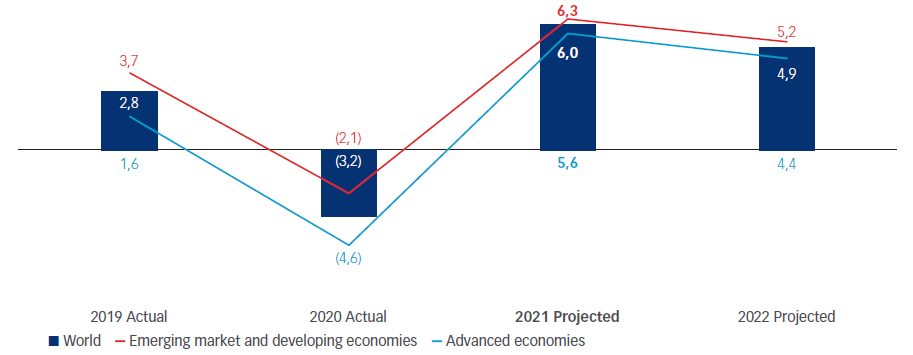
Source: IMF World Economic Outlook Update, July 2021.
Exchange rate volatility
Our financial reporting is in South African Rand and fluctuations in this currency have had a resultant impact on the Group's reported financial results. For the 2021 financial year, the EUR/ZAR exchange rate averaged R18,362 (2020: R17,327) and the USD/ZAR exchange rate averaged R15,408 (2020: R15,677). In the months following year-end, the Rand has continued to experience some volatility, slightly weakening against major developed market currencies.
Average exchange rates for top six currencies by revenue contribution indexed to 100 (FY2020 = 100)

Demographic shifts influencing global healthcare needs
Key demographic trends are changing the world we live in:
- The world's population is projected to increase to 8,5 billion people by 2030 and reach almost 10 billion by 2050. The current population of sub-Saharan Africa is projected to double by 2050;
- Global ageing is expected to accelerate in the coming decades as a result of significant gains in life expectancy in recent years coupled with declining fertility rates;
- The potential support ratio, which compares numbers of working-age people aged 25 to 64 to those over age 65, is declining; and
- Increasing urbanisation and improved economic activity result in better informed patients, actively involved in sustaining their health with increasing expectations for access to medicines and surgical procedures. In turn, this creates greater socio-economic awareness and political pressure to ensure broader and affordable access to healthcare solutions.
The improvement in life expectancy, increased population growth, predominantly in the developing world, and the resultant increase in demand for access to healthcare creates a number of opportunities, but it also results in significant challenges. These demographic shifts result in larger populations requiring healthcare for longer periods. The prevalence and diagnosis of non-communicable diseases and so-called lifestyle diseases and chronic conditions, such as cancer as well as cardiovascular, metabolic and respiratory diseases, are increasing, particularly in developing countries as their populations grow. This increasing demand for healthcare is placing a significant strain on already burdened healthcare systems and limited healthcare budgets.
Ongoing pressure on medicine pricing
The increasing demand for healthcare, partly driven by demographic and socio-economic factors, continues to place strain on public healthcare systems. The COVID-19 pandemic has significantly increased this pressure as these systems deal with recurring waves of infection, surges in demand for treatments that were delayed during the pandemic, the expected longer-term health complications in COVID-19 recovered patients as well as the challenge of rolling out national vaccination programmes. The debate on access to affordable healthcare, pricing and reimbursement has gained momentum in policy discussions across the world as countries seek to achieve better value in healthcare spending. A number of countries have introduced rigorous measures to address this pressure through various controls on pricing and reimbursement. China has, for example, expanded its volume-based procurement programme started in 2018, resulting in significant competition and material price cuts in respect of certain products. Healthcare companies are being increasingly challenged to demonstrate the clinical and economic value of their products in new ways. Achieving the appropriate balance between providing a sustainable return on investment for pharmaceutical companies, while ensuring that treatments remain affordable to patients who need them, is a persistent challenge for healthcare systems globally. The need for this balance emphasises the importance of older, off-patent medicines, which have proven therapeutic outcomes and offer more affordable treatment for many disease types.
Climate change impacts business sustainability and human health
Climate change affects every aspect of human existence, from access to water and food, to severe weather events and pollution. Climate events threaten supply and distribution chains, creating uncertainty regarding the continued availability of resources required to sustain current operating models. It also affects the social and environmental influences on human health, such as clean air, safe drinking water, sufficient food, secure shelter and the prevalence of vector-borne diseases. The most recent Intergovernmental Panel on Climate Change report highlights that climate change is widespread, rapid and intensifying. There is an increasing call for companies to take strong and enduring action to respond to these environmental risks and adapt their strategies to address sustainability issues in the broader societal context.
Accelerated digitalisation
Innovation in technology continues to evolve rapidly, reshaping the way we live, work and interact with each other. In the healthcare industry, advances in artificial intelligence as well as digital technology and data analytics are enabling researchers to explore and interpret increasing volumes of data more efficiently. Further innovations in the enhancement of digital connectivity, remote monitoring and care technology, as well as developments in wearable technology, are revolutionising diagnosis, treatment planning, patient monitoring and long-term care. Intelligent technologies are optimising manufacturing and enhancing communication with customers and patients. With the increase in access to data and the "Internet of Things", concerns around data security, privacy and business interruption are top of the agenda, especially as the number of data breaches, ransomware attacks and malware attacks is trending upwards. The increased dissemination of false information or "fake news" and its impact on society and patient decisions about treatment options is also an area receiving enhanced regulatory scrutiny.
The future of work
The pace of change is affecting not only how people live, but also how they work. While these shifts began prior to COVID-19, the global crisis brought about by this pandemic has greatly accelerated this change. Workplaces are becoming less hierarchical, more automated and more digital. As new roles and ways of working emerge, organisations are re-assessing the skill sets needed to respond to evolving business priorities, while employees are demanding more flexibility and increasingly seeking out fair, inclusive and purposeful employers to work for. In an environment where competition for the right talent remains fierce, companies offering more flexible approaches to employment and which foster a supportive and inclusive workplace culture will be better positioned to attract and retain the best people.
Outlook for the pharmaceutical industry remains positive
Despite the near-term challenges caused by the COVID-19 pandemic, the broader outlook for the pharmaceutical industry remains positive. Evaluate Pharma's World Preview 2021, Outlook to 2026 (June 2021) finds that prescription drug sales are forecast to reach USD1,4 trillion in 2026, a compound annual growth rate ("CAGR") of 6,4% from 2021 to 2026 (compared to the annual compound rate of 2,7% achieved over the period 2012 to 2019). The anticipated launch of novel therapies addressing key unmet needs, as well as the growing demand from emerging economies are expected to be the major growth drivers. Tempering this growth outlook are factors such as increased scrutiny by those who pay for healthcare solutions as well as revenue losses due to genericisation and biosimilar competition.
The IQVIA Institute's Global Medicine Spending and Usage Trends report (April 2021) predicts spending on medicines in pharmerging markets* to grow between 7% to 10% CAGR to 2025, driven primarily by increasing per capita use, while some markets are seeing an uptake of new medicines as the ability of patients to afford their share of costs improves with economic growth. This compares to a predicted CAGR of 2% to 5% for developed countries.
Predicted market share by 2025 (%)

| * | IQVIA defines pharmerging markets as those with per capital income below USD30 000 and a five-year aggregate pharmaceutical growth over USD 1 billion. |
Source: Global Medicine Spending and Usage Trends, Outlook to 2025, IQVIA Institute, April 2021
Our response to the external environment
We identify our emerging threats and opportunities based on an ongoing assessment of those global trends likely to have a material bearing on the Group's operating environment and business model. Early identification of these trends enables us to leverage opportunities or to proactively mitigate the possible resultant negative impacts.
Access to healthcare is one of the biggest challenges facing modern society. Our contribution, as a manufacturer and distributor of pharmaceuticals, is to ensure the supply of high quality, affordable medicines which provide value through meeting the medical needs of patients. We continue to carefully shape our product portfolio to achieve a diverse product range in targeted therapeutic areas focusing on specialty products and unique, trusted brands in specific regional territories, underpinned by our expertise in complex manufacturing and supply chain management.
We have made significant investments in upgrading our older medicines to meet modern regulatory requirements, providing value-for-money alternatives to new and more expensive innovative drugs. Our product portfolios have strong brand equity, supporting the promotion of both our global Sterile Focus and Regional Brands therapeutic segments. Our Regional Brands comprise a diverse range of products, including OTC and generic products, achieving further diversification in our product portfolio. Our off-patent branded portfolio of complex Sterile Focus Brands, while not invulnerable to pricing pressure, is competitively priced and has demonstrated clinical value.
We have a distribution network supplying medicines to more than 150 countries and territories, with a strong presence in both developed and emerging markets, reducing our exposure to market risks in any one country or risk to one currency. This is enabled by an effective supply chain model, supported by in-country distribution aimed at maximising the reliable supply to many geographies and making our medicines available to a significant population of patients. This provides us with the opportunity to leverage the increasing demand for medicines driven by demographic trends, supported by global capabilities with a commercial approach tailored for each country.
We have continued to invest in our manufacturing capacity and have expanded our capability in manufacturing niche products with a high degree of complexity, including APIs and sterile FDF manufacturing. This includes adapting and enhancing our existing sterile manufacturing facilities to facilitate vaccine production. Increased manufacturing volumes, optimisation of our operating model and a focus on manufacturing efficiencies provide for enhanced synergies, thereby unlocking value creation in the restrictive price environment.
We have initiated several organisational projects designed to position the Group to meet the dynamic environment. These include reviews of our operating models, structures and human resource management to design an organisation fit for purpose. Greater emphasis has been placed on our investment in digital resources and platforms to provide agile, world-class operating environments across our businesses.
We understand that high ethical standards, strong corporate governance and a stakeholder-inclusive approach are essential to maintaining our reputation and successfully navigating the complex, dynamic and uncertain global environment in which we operate. A key issue for the pharmaceutical industry is to retain the trust of its stakeholders, including governments, regulators, patients and society at large. Responsible corporate citizenship and sustainability objectives underpin our strategy. We are in the process of performing a strategic review of our Sustainability and ESG strategy and are re-evaluating our response to climate change risk.